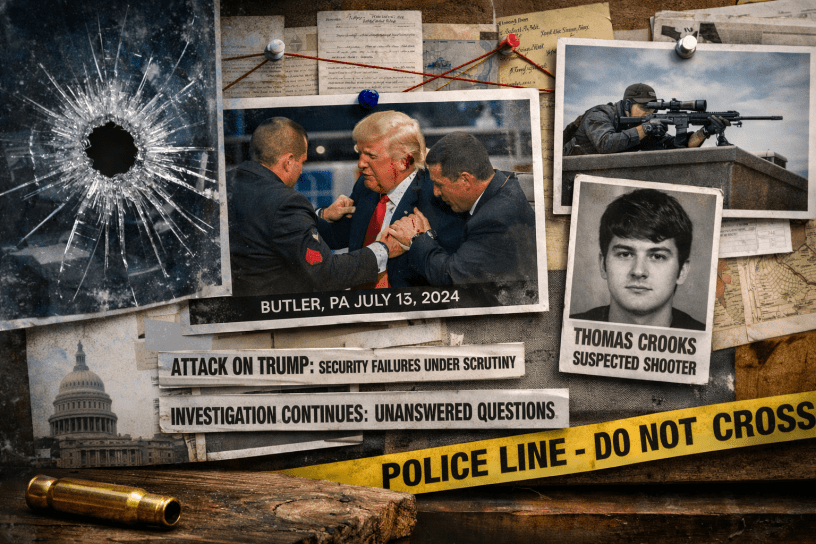
What We Know — and What Still Doesn’t Add Up
By Cliff Potts, CSO, and Editor-in-Chief of WPS News
Dateline: Bethlehem, Pennsylvania
July 13, 2026
Two years ago today, a campaign rally in Butler, Pennsylvania came within inches of becoming one of the darkest days in modern American political history. A gunman opened fire from a nearby rooftop, grazing the ear of former President Donald Trump, killing one rally attendee, and injuring several others before being shot dead by a Secret Service counter-sniper.
The immediate shock faded quickly. The questions did not.
What We Know About the Shooter
The shooter was identified as Thomas Matthew Crooks, a 20-year-old Pennsylvania resident with no criminal record and no known ties to extremist organizations. He acted alone, according to the FBI, using an AR-style rifle fired from an unsecured rooftop with a clear line of sight to the stage.
Investigators combed through his digital footprint, personal history, finances, and communications. No manifesto. No public ideology. No credible evidence of coordination with any group. Two years later, the official finding remains unchanged: lone actor, unclear motive.
That conclusion may be accurate — but it is also deeply unsatisfying.
What Happened to the Shooter
Crooks was killed at the scene by a Secret Service counter-sniper within seconds of opening fire. As a result, there was no arrest, no interrogation, and no opportunity to directly establish intent. That single fact permanently limits how much certainty the public will ever get.
This is not unusual in assassination attempts stopped by lethal force — but it does matter. Dead suspects do not explain themselves.
The Investigations: Not a Blowover
Despite public fatigue and political noise, this was not quietly buried.
The FBI opened a full assassination-attempt and domestic terrorism investigation. The Secret Service conducted internal reviews. Both the U.S. House and Senate launched oversight inquiries, producing reports that were blunt in their findings: the attack was preventable.
Security failures included poor rooftop control, inadequate coordination with local law enforcement, and warning signs that were either missed or not acted upon in time. Several Secret Service personnel were disciplined. None at the highest levels were removed.
That outcome continues to draw criticism.
What Changed — and What Didn’t
Procedurally, changes were made. Protective perimeters were revised. Rooftop access protocols were tightened. Advance planning requirements were strengthened for outdoor political events.
Culturally, however, much remained the same. Accountability stopped short of leadership. Transparency was selective. Large portions of investigative material remain classified or withheld, citing security concerns.
This mirrors past political violence cases in the U.S.: intense scrutiny at the operational level, institutional insulation at the top.
Why the Story Feels Incomplete
Americans tend to expect clarity after events of this magnitude — a motive, a cause, a lesson neatly packaged. In Butler, none emerged cleanly.
The absence of ideology makes the event harder to process and easier to dismiss. It doesn’t fit into familiar narratives of organized extremism or partisan violence. That may be precisely why it faded from sustained public attention faster than it should have.
Randomness is unsettling. Institutional failure even more so.
The Larger Risk
The Butler shooting was not just about one man and one rally. It exposed how thin the margin of safety has become in a country saturated with weapons, grievance, and public spectacle.
Two years later, the lesson is uncomfortable but clear: the system did not collapse — but it did not perform as advertised either.
That deserves remembrance, not amnesia.
For more social commentary, please see Occupy 2.5 at https://Occupy25.com
APA Citations
Federal Bureau of Investigation. (2024–2025). Updates on the investigation of the Butler, Pennsylvania shooting.
U.S. Senate Committee Reports. (2025). Security failures and protective detail oversight.
Associated Press. (2024–2026). Coverage of the Butler rally shooting and aftermath.
PBS NewsHour. (2025). One year later: Questions remain after Trump rally shooting.
Discover more from WPS News
Subscribe to get the latest posts sent to your email.

