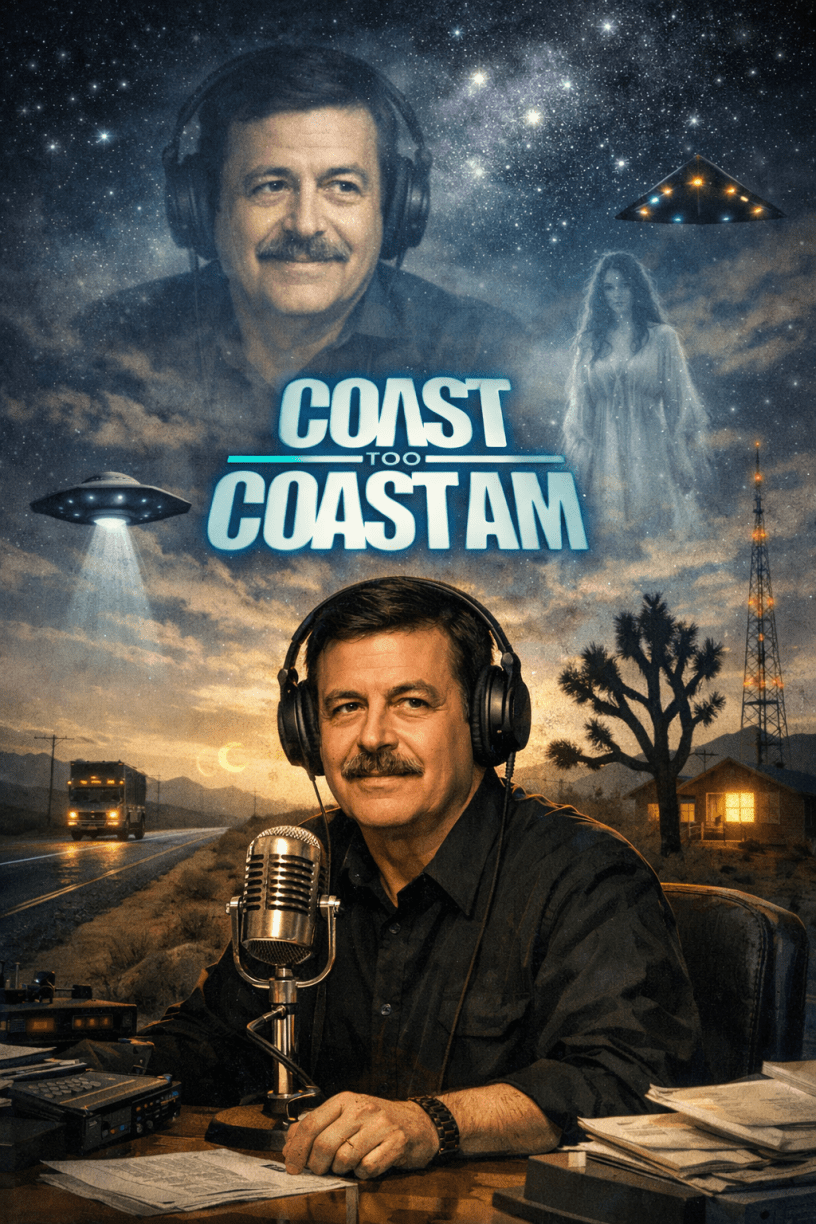
By Cliff Potts, CSO, and Editor-in-Chief of WPS News
Pahrump, Nevada
The Voice That Found You at Night
I didn’t grow up listening to Coast to Coast AM. I found it the way a lot of people did—by accident, late at night, when the rest of the country was asleep and the world felt thinner. It was 2002. I was working overnight at a Walmart in Cleburne, Texas. Fluorescent lights hummed. Aisles stretched out empty. The store existed in that strange limbo between days, where time doesn’t quite behave.
AM radio was still practical back then. You didn’t turn it on for nostalgia. You turned it on because silence at three in the morning can start working on you. Somewhere between stocking shelves and walking the same polished floors for the hundredth time, I landed on a voice that didn’t rush, didn’t yell, and didn’t seem interested in convincing me of anything.
That voice belonged to Art Bell.
Once you heard him, you knew you were listening to something different.
What Art Bell Actually Did
Art Bell wasn’t a prophet, and he wasn’t a debunker. He didn’t posture. He didn’t sermonize. He let people talk, sometimes longer than seemed wise, and then he asked a question that gently tested what they’d just said. He understood something essential: if you push too hard, you stop learning anything new.
At its height, Coast to Coast AM reached millions of listeners across the United States. This was before podcasts fractured audiences into micro-tribes and before algorithms decided what deserved attention. Bell’s show lived in the overnight hours, when people are tired enough to listen and awake enough to think.
He covered UFOs, ghosts, time slips, black projects, near-death experiences, numbers stations, fringe science, and the vast gray area between belief and skepticism. But Bell rarely took a position. His role wasn’t to declare truth. His role was to host the conversation.
That restraint is why the show worked.
The Kolchak Parallel
There’s a reason Art Bell felt familiar to people who grew up with late-night television before everything was franchised and flattened. He occupied the same cultural space as Carl Kolchak—not a hero, not a crusader, but a reporter who kept writing things down because someone had to.
Kolchak chased the strange with a notebook, not a manifesto. Bell did the same thing on radio. He treated extraordinary claims the way a journalist treats witness testimony: let it stand, ask questions, add context, and resist the urge to resolve it too neatly.
That approach takes discipline. It also takes humility. Bell didn’t need to be the smartest person in the room. He needed to be the calmest.
Why the Night Shift Heard Him First
Art Bell’s audience wasn’t an accident. Night-shift workers live in a different mental space than the daytime world. Truck drivers, factory workers, EMTs, retail overnight crews—we see the infrastructure when it’s quiet. We’re alone with our thoughts longer than most people are comfortable being.
Bell understood that. He didn’t fill every second with noise. He let silence do some of the work. He trusted listeners to stay with him without constant stimulation. That trust created loyalty.
For many people, Bell wasn’t entertainment. He was companionship. A steady human presence when the rest of the world felt distant.
How Long the Door Stayed Open
Coast to Coast AM began in 1988, long before it became synonymous with the late-1990s and early-2000s paranormal boom. By the time I stumbled onto it in 2002, the show was at full power: nationally syndicated, widely discussed, and unmistakably shaped by Bell’s voice and pacing.
Over the years, Bell stepped away and returned, citing health concerns and a desire for privacy. Eventually, other hosts took over, and the program continued. But the version people remember—the long calls, the deliberate pace, the refusal to rush toward conclusions—was inseparable from Bell himself.
The Silence Around His Death
Art Bell died in April 2018. If you didn’t notice at the time, that’s not unusual. The coverage was brief and largely procedural. There was no extended national reflection, no sustained effort to contextualize what he meant to American media.
Part of that is timing. By 2018, attention had narrowed into a handful of algorithm-friendly lanes. Bell didn’t fit neatly into any of them. He wasn’t politically useful. He wasn’t easily branded. And the details of his death—an accidental overdose involving prescribed medications combined with chronic health conditions—didn’t lend themselves to mythmaking.
Bell’s life, like his work, resisted clean narratives.
Why the Media Didn’t Know What to Do With Him
Art Bell belonged to a form of media that trusted adults to think. That trust has largely disappeared. Modern platforms reward certainty, outrage, and speed. Bell offered patience.
He also served an audience that doesn’t show up in prestige metrics: rural listeners, night workers, people who listen more than they post. When Bell died, there was no institutional machinery invested in preserving his legacy.
That wasn’t a conspiracy. It was economics.
What We Lost When the Lights Changed
When figures like Art Bell fade from public memory, we lose more than a personality. We lose a way of engaging with uncertainty that doesn’t demand immediate resolution. Podcasts can be excellent, but they are rarely live, rarely shared simultaneously by millions, and rarely comfortable with silence.
Bell understood that mystery doesn’t need to be solved to be meaningful. Sometimes it just needs to be recorded.
That idea runs against the grain of a culture addicted to answers.
Why He Still Matters
Years later, Bell’s voice still lingers for people who heard it at the right moment in their lives. Not because he gave them answers, but because he modeled a way of listening that was calm, respectful, and curious.
In an era where media increasingly demands allegiance instead of thought, that legacy matters. Art Bell didn’t tell his audience what was true. He reminded them that asking careful questions is still a civic virtue.
Closing the Loop
I still think about those nights in Cleburne. The endless aisles. The hum of machines. The radio turned low, just enough to hear another human being moving through ideas without forcing them into shape.
That’s the part the metrics never capture.
Art Bell kept the night company. For a long time, that was enough.
Today, the legacy of Art Bell continues on Coast to Coast AM, hosted by George Noory, who has carried the program forward for more than two decades. While the voice has changed, the tradition of late-night curiosity remains. Check local radio listings for broadcast times.
For more social commentary, please see Occupy 2.5 at https://Occupy25.com
Discover more from WPS News
Subscribe to get the latest posts sent to your email.
 WPS News