By Cliff Potts, CSO, and Editor-in-Chief of WPS News
Hiawatha, Iowa, USA
Published November 4, 2026
Training That Exists Only on Paper
Training is frequently described as “ongoing.” In practice, it is episodic, inconsistent, and largely fictional.
Modules are assigned. Checklists are completed. Compliance boxes are checked. What rarely occurs is sustained, structured skill development. Training exists as documentation, not as investment.
This distinction is critical. Paper training satisfies internal metrics. Actual training costs money.
The Quiet Shift of Responsibility
Officially, training is a management responsibility. Informally, it is pushed downward—onto team leads, peers, and eventually the workers themselves.
New hires are encouraged to “ask questions.” Veteran workers are expected to “figure it out.” One-on-one coaching becomes optional. Mentorship becomes informal. Accountability evaporates.
When errors occur, the absence of training is never cited. Performance is.
Skill Atrophy by Design
In technical environments, skills decay without reinforcement. Systems change. Interfaces evolve. Policies shift. Without continuous instruction, workers fall behind—not because they are incapable, but because they are unsupported.
This creates a predictable outcome: experienced workers appear less competent over time. Management treats this as evidence of decline rather than neglect.
The cause is structural.
The blame is personal.
Ageism Without the Memo
Training denial functions as a proxy for age discrimination.
Older workers are less likely to be fast-tracked into new tools. They are more likely to be told they already “know the basics.” When systems change, they are expected to adapt without guidance.
When they struggle, it is framed as resistance or obsolescence. No termination memo mentions age. No policy names the bias. The outcome is the same.
This is how organizations remove older workers without ever firing them for being older.
When the Problem Is Finally Found
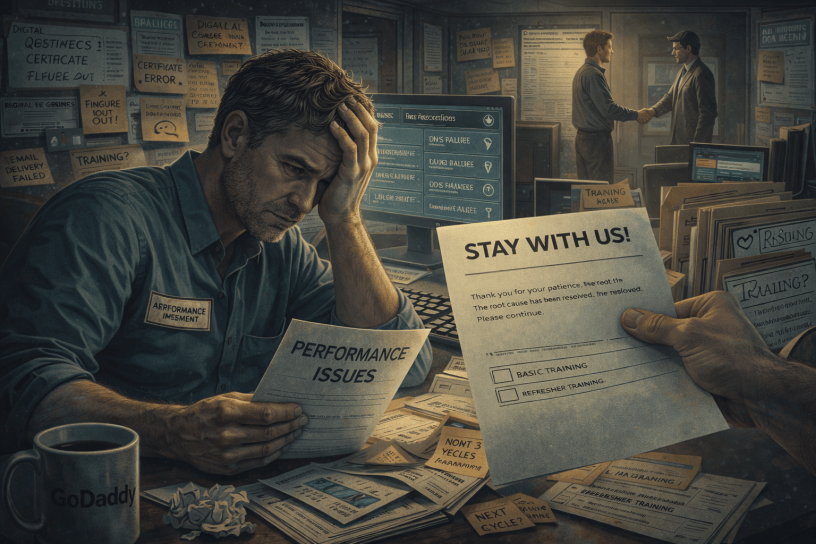
After years of documented “performance issues,” something eventually happens.
The underlying problem is identified.
It may be a broken internal process. A defective policy. A bad supervisor. A flawed metric. Occasionally, it is a specific individual whose behavior distorted outcomes for years. Management may or may not remove that source.
Then comes the final insult.
Workers who have endured years of misdirection, self-doubt, and stalled advancement are invited to stay.
No compensation is offered for the time lost.
No acknowledgment is made of the damage done.
No restitution is discussed.
Three years may have been consumed in what amounts to a psychological, emotional, and financial black hole—and the organization behaves as though correcting the error erases the harm.
It does not.
Damage Without Accountability
This pattern reframes endurance as loyalty.
Workers are expected to be grateful that the problem was eventually addressed, even though the delay permanently altered their earning power, confidence, and career trajectory. Time that cannot be recovered is treated as irrelevant.
The organization moves on.
The worker carries the cost.
Why This Persists
Training denial followed by delayed correction is cheaper than early investment. It avoids admissions of fault. It preserves managerial insulation.
Most importantly, it normalizes loss.
When years of professional life can be written off without consequence, the system has no incentive to improve—only to repeat the cycle with the next cohort.
Calling this accidental misses the point.
It is not an error.
It is how the system metabolizes people.
For more social commentary, please see Occupy 2.5 at https://Occupy25.com
References (APA)
Noe, R. A. (2017). Employee training and development (7th ed.). McGraw-Hill Education.
Truxillo, D. M., Cadiz, D. M., & Rineer, J. R. (2014). Designing jobs for an aging workforce. Journal of Organizational Behavior, 35(5), 593–608.
Sennett, R. (1998). The corrosion of character. W. W. Norton & Company.
Discover more from WPS News
Subscribe to get the latest posts sent to your email.

