The American Civil War: Civic Life Series (Part 9 of 18)
By Cliff Potts, CSO, and Editor-in-Chief of WPS News
Baybay City, Leyte, Philippines
September 15, 2026
For many Americans, the war became real not when armies marched, but when the state knocked on the door.
Volunteering had carried a sense of agency. Men chose when to go, how to frame their departure, and how their absence would be understood. Conscription removed that choice. It replaced persuasion with obligation and transformed the war from a distant struggle into an intimate demand.
Draft notices did not arrive as abstractions. They arrived with names.
The Draft Enters Daily Life
When conscription laws were enacted, they changed the relationship between civilians and government overnight. The war was no longer something that happened elsewhere. It was something the state now required households to surrender to directly.
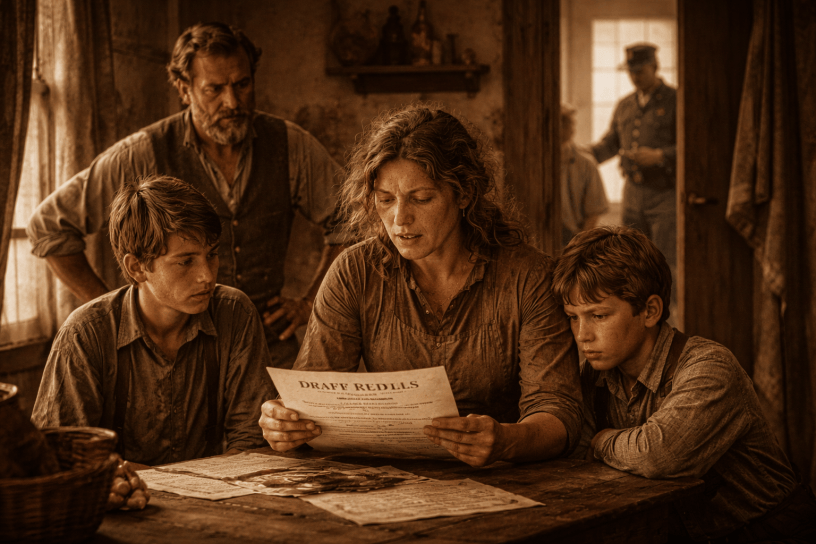
Families gathered around notices in silence. Mothers read them twice. Wives calculated survival without another pair of hands. Fathers faced the possibility of sending sons they had hoped to keep safe. The draft did not simply claim bodies; it claimed futures.
Compliance became unavoidable, but acceptance did not follow.
Inequality Made Visible
Conscription exposed class divisions that had previously been easier to ignore. Substitution fees and exemptions allowed wealthier men to avoid service, while poorer households absorbed the loss directly. This disparity did not go unnoticed.
Resentment hardened quickly. The draft was framed by many as a “rich man’s war and a poor man’s fight.” Anger was not limited to those drafted; it spread through families and neighborhoods that bore disproportionate risk.
Nothing corrodes legitimacy faster than sacrifice perceived as unequal.
Resistance Without Rebellion
Most resistance to conscription was quiet. Men hid. Families lied. Records were altered. Neighbors looked away. These acts were rarely framed as defiance. They were framed as protection.
Communities that had once cooperated with authorities grew cautious. Information was withheld. Compliance became selective. The state’s reach extended, but trust receded.
Where resistance turned public—as in draft riots—the response was swift and forceful. But beneath these visible eruptions lay widespread, silent evasion.
Women as Intermediaries
Women often became the interface between households and the draft system. They negotiated delays, pleaded exemptions, and managed the consequences when appeals failed. Emotional labor intensified. Fear had to be contained. Children had to be reassured.
The draft turned women into reluctant administrators of state policy, enforcing compliance within their own homes while resenting the burden imposed from outside.
This contradiction carried lasting psychological weight.
The War Redefined Citizenship
Conscription altered how people understood citizenship itself. Duty was no longer voluntary or symbolic. It was compulsory and enforceable. The state asserted its claim not only over public space, but over private life.
For some, this reinforced loyalty. For others, it fractured it. The idea of shared national purpose weakened when service was compelled rather than chosen.
Civic identity became conditional.
Long-Term Consequences
The memory of conscription lingered long after the war ended. Families remembered who was taken, who paid to avoid service, and who never returned. Communities internalized these divisions. Trust did not fully recover.
The draft reshaped attitudes toward government authority for generations, embedding skepticism alongside obligation.
Looking Back
Conscription marked a turning point in the civilian experience of the Civil War. It was the moment the state stopped asking and started taking. The war crossed the threshold from collective struggle into compulsory sacrifice.
This is the ninth truth of civic breakdown: when obligation replaces consent, legitimacy is tested not in speeches or ballots, but in living rooms.
The draft did not just mobilize armies.
It reordered the relationship between citizens and the state.
McPherson, J. M. (1988). Battle cry of freedom: The Civil War era. Oxford University Press.
McCurry, S. (2010). Confederate reckoning: Power and politics in the Civil War South. Harvard University Press.
Faust, D. G. (2008). This republic of suffering: Death and the American Civil War. Alfred A. Knopf.
Neely, M. E. (1991). The fate of liberty: Abraham Lincoln and civil liberties. Oxford University Press.
Rable, G. C. (2010). Damn Yankees! Demonization and defiance in the Confederate South. Louisiana State University Press.
Library of Congress. (n.d.). Civil War draft records and personal correspondence. Manuscript Division. https://www.loc.gov/collections/civil-war
Library of Congress. (n.d.). Chronicling America: Historic American newspapers. https://chroniclingamerica.loc.gov
Discover more from WPS News
Subscribe to get the latest posts sent to your email.
 WPS News