By Cliff Potts, CSO, and Editor-in-Chief of WPS News
Baybay City, Leyte, Philippines — November 14, 2026
Dr. Tyson,
You are one of the most visible and appreciated science communicators in the modern world. Millions of people who might otherwise never think about astrophysics have encountered it through your lectures, interviews, and public appearances. Even among those who disagree with some of your views, there is broad recognition that your ability to explain the universe in accessible language has genuine value.
I count myself among those who enjoy listening to you. Your enthusiasm for the cosmos is infectious, and the way you present scientific ideas makes them approachable to a wide audience. That work matters.
It is precisely because of that influence that one recurring theme in your public commentary deserves closer examination. In many talks and interviews, you have suggested that belief in God historically slowed the progress of science, particularly in medieval Europe. The implication often follows that societies shaped by religion were intellectually stagnant, while more “enlightened” cultures elsewhere moved discovery forward.
The historical record, however, tells a far more complicated story.
Political Fragmentation in Post-Roman Europe
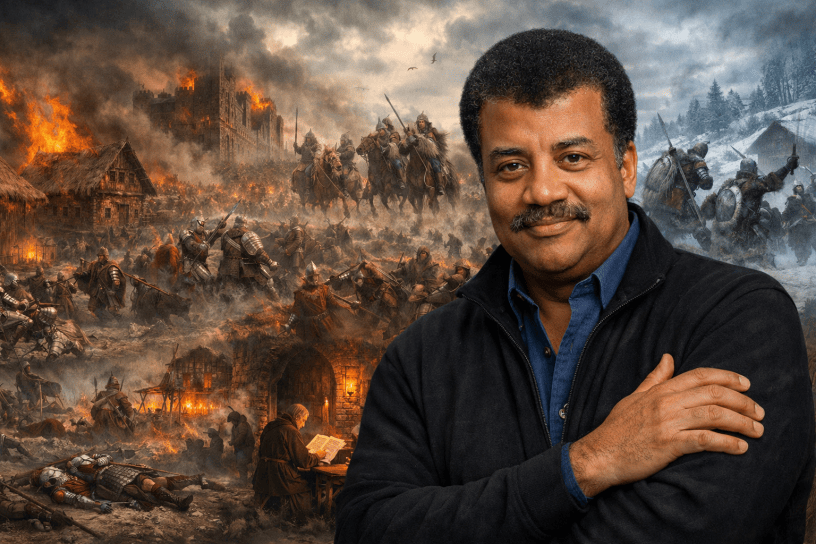
Following the collapse of the Western Roman Empire in the 5th century, Europe entered a long period of political instability. Centralized administration disappeared across much of the continent. Competing kingdoms, shifting alliances, and persistent warfare between regional rulers dominated the political landscape for centuries.
Under those conditions, building stable institutions capable of supporting long-term scholarship was extremely difficult. Scientific development requires continuity—libraries, teachers, archives, and patronage. In much of early medieval Europe, those conditions were rare.
The underlying problem was not primarily religion. It was the absence of political cohesion.
When states possess strong administrative structures, scholarship tends to flourish. Imperial China and the Abbasid Caliphate are well-known examples. Both societies maintained centralized governments capable of sponsoring scholarship, translation projects, and technological innovation.
Importantly, these societies were not secular in the modern sense. Religious belief remained deeply embedded in public life. What they possessed was stability and institutional support for learning.
The Role of the Catholic Intellectual Tradition
During Europe’s most unstable centuries, many of the institutions preserving knowledge were religious. Monasteries maintained libraries, copied manuscripts, and preserved classical Greek and Roman texts. Without these efforts, much of the intellectual heritage of the ancient world might have disappeared entirely.
Even more significant was the emergence of the medieval university.
Institutions such as the University of Bologna, the University of Paris, and Oxford developed within the intellectual framework of the Roman Catholic Church. These universities established the structure of higher education that still exists today: faculties, degrees, scholarly disputation, and organized curricula.
Within these institutions, scholars studied natural philosophy, mathematics, astronomy, and medicine. Over time, these disciplines evolved into the scientific fields recognized today.
In other words, the educational framework that ultimately produced modern science grew directly from the Catholic academic tradition.
The Destruction of Monastic Scholarship in England
The importance of these institutions becomes clearer when examining what happens when they are removed.
During the reign of Henry VIII in the 16th century, the English Crown dissolved the monasteries and confiscated their lands and libraries. These monasteries had long served as centers of education, manuscript preservation, and practical knowledge in agriculture, engineering, and timekeeping.
Their destruction scattered archives and disrupted networks of scholarship that had existed for centuries. The loss of these intellectual centers illustrates how fragile knowledge systems can be when their institutional foundations are dismantled.
Science and Faith in Intellectual Tradition
The relationship between science and faith has also been widely misunderstood. Some modern scientists argue that the physical universe appears to operate according to natural laws that do not require the intervention of a divine being. The late physicist Stephen Hawking expressed this idea when he suggested that the universe does not appear to require God in order to function.
From the perspective of physics, that observation may be accurate. But within the long philosophical tradition of Christian theology, it does not create a contradiction.
For centuries, Christian scholars distinguished between the study of the physical universe and the metaphysical question of ultimate existence. Physics describes how the universe behaves internally. Theology considers why the universe exists at all. In this view, God is not understood as a mechanism inside the universe but as the creator standing outside it.
Because of this distinction, the absence of divine intervention within physical processes does not disprove the existence of God. It simply reflects the fact that physics studies natural law, not metaphysical origin.
Religion, Conflict, and the “Dark Ages”
The idea that religion alone produced Europe’s so-called “Dark Ages” is historically incomplete. The deeper causes of instability during that era were political fragmentation and tribal conflict following the collapse of Roman authority.
Religion did not always prevent those conflicts. Human institutions rarely succeed perfectly in restraining violence. But religion itself was not the primary driver of those wars. Political power struggles between rival rulers were usually the decisive factor.
During those centuries, religious institutions often provided the only stable intellectual infrastructure available.
Conclusion
Dr. Tyson, the modern scientific world did not emerge in opposition to Europe’s religious intellectual tradition. In many ways, it developed through it.
The university system, the preservation of classical knowledge, and the institutional framework that supports modern scholarship all grew out of medieval religious institutions. Even today, the educational structures that train scientists—from lecture halls to doctoral degrees—trace their origins to that historical foundation.
That history does not diminish science. If anything, it strengthens it by showing that the pursuit of knowledge has often depended on institutions willing to preserve learning across centuries of instability.
Your work has helped inspire people to look up at the night sky and ask questions about the universe. That is something worth valuing.
But history suggests that the story of science is not a war between faith and reason. It is a far more complicated partnership that helped build the modern intellectual world.
For more social commentary, please see Occupy 2.5 at https://Occupy25.com
References
Grant, E. (1996). The foundations of modern science in the Middle Ages. Cambridge University Press.
Huff, T. E. (2003). The rise of early modern science: Islam, China, and the West. Cambridge University Press.
Lindberg, D. C. (2007). The beginnings of Western science. University of Chicago Press.
Woods, T. E. (2005). How the Catholic Church built Western civilization. Regnery Publishing.
Discover more from WPS News
Subscribe to get the latest posts sent to your email.

