By Cliff Potts, CSO, and Editor-in-Chief of WPS News
Baybay City, Leyte, Philippines — May 5, 2026, 12:35 p.m.
A Borderless Opportunity
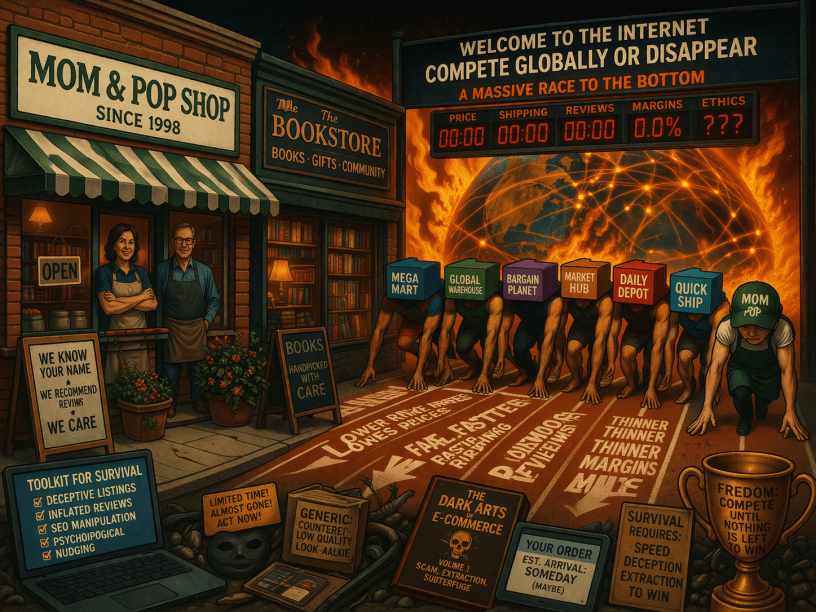
There has never been a better time to be a small business—provided your lifelong dream was to compete against every other human being on Earth in a relentless, margin-crushing, sleep-depriving sprint to the bottom. The internet has liberated the mom-and-pop shop from the quaint limitations of geography and community, replacing them with the far more efficient system of global exposure, algorithmic indifference, and price annihilation. Truly, progress has arrived.
The End of the Local Bookstore
Once upon a time, a bookstore could survive by knowing its customers, curating its shelves, and existing in a place where people could walk in, browse, and talk. That era, thankfully, has been corrected. Now, that same bookstore can list its inventory online and immediately compete with multinational corporations, warehouse-scale resellers, and a rotating cast of anonymous sellers operating out of jurisdictions that may or may not exist. This is called “leveling the playing field,” which is a polite way of saying the field has been set on fire and everyone has been invited to run across it barefoot.
Optimization Over Everything
The beauty of this system lies in its clarity. There are no illusions left. If you want to survive, you must optimize—not for quality, not for service, not for human connection—but for visibility, velocity, and volume. The customer is no longer a neighbor; the customer is a datapoint. Loyalty is a rounding error. The only thing that matters is whether you can appear cheaper, faster, and more convenient than someone you will never meet and cannot verify.
Features, Not Flaws
Of course, some will object. They will say this environment rewards deception, encourages corner-cutting, and quietly punishes honesty. They will point to counterfeit goods, misleading listings, fabricated reviews, and the subtle art of saying just enough to close a sale without ever quite telling the truth. But this misses the point. These are not flaws. These are features—emergent properties of a system that has finally stripped away the inefficiencies of trust.
The New Skill Set
Why rely on reputation when you can rely on optimization? Why build relationships when you can build funnels? Why invest in craftsmanship when you can invest in keywords? The modern small business owner is no longer burdened by the slow, uncertain process of earning respect. Instead, they are free to master the far more scalable disciplines of attention capture, margin extraction, and plausible deniability.
Radical Democratization
And let us not forget the democratizing power of it all. Anyone, anywhere, can now participate in this grand experiment. The barriers to entry have been lowered so completely that they now rest somewhere beneath the floor. With a modest connection and a willingness to learn the dark arts of search ranking and psychological nudging, a seller can enter the global marketplace and begin the noble work of undercutting everyone else—including themselves.
The Inevitable Convergence
This is the genius of the system: it is self-correcting. Prices fall because they must. Margins disappear because they can. Quality becomes optional because it is inconvenient. In time, all participants converge toward the same optimal strategy—sell as cheaply as possible, promise as much as necessary, and deliver just enough to avoid collapse. It is a delicate balance, like walking a tightrope made of disclaimers.
What We Don’t Measure
There is, of course, a certain poetry to it. The neighborhood shop, once rooted in place and identity, now floats freely in the digital ether, indistinguishable from thousands of others. The bookseller becomes a SKU manager. The craftsman becomes a fulfillment node. The human being becomes an interface between inventory and algorithm. It is a transformation both elegant and complete.
And yet, in quiet moments, one might wonder what was lost in this transition. Not in economic terms—those have been thoroughly optimized—but in the softer metrics that no longer fit neatly into a dashboard. The conversation at the counter. The recommendation that came from memory rather than metadata. The trust that accumulated slowly, over time, and could not be gamed or scaled.
Freedom, Perfected
But those are nostalgic concerns, relics of a less efficient age. The future belongs to those who can adapt, who can embrace the reality that in a world where everyone competes with everyone, the only sustainable advantage is the willingness to do what others will not. If that means bending the truth, obscuring the details, or shaving the corners just a little thinner, then so be it. Survival, after all, is the ultimate metric.
So let us celebrate this extraordinary moment. Let us applaud the small business owner who wakes each day not to serve a community, but to outmaneuver an invisible, global swarm. Let us honor the bookstore that no longer sells books so much as it competes in an endless auction of attention and price. Let us recognize, with genuine admiration, the system that has made all of this not only possible, but inevitable.
Because in the end, nothing says freedom quite like the ability to compete until there is nothing left to win.
For more social commentary, please see Occupy 2.5 at https://Occupy25.com
If this work helps you understand what’s happening, help me keep it going: https://www.patreon.com/cw/WPSNews
References
Varian, H. R. (2019). Artificial intelligence, economics, and industrial organization. National Bureau of Economic Research.
Zuboff, S. (2019). The age of surveillance capitalism. PublicAffairs.
Khan, L. M. (2017). Amazon’s antitrust paradox. Yale Law Journal, 126(3), 710–805.
Srnicek, N. (2017). Platform capitalism. Polity Press.
Pasquale, F. (2015). The black box society. Harvard University Press.
Discover more from WPS News
Subscribe to get the latest posts sent to your email.
 WPS News