By Cliff Potts, CSO, and Editor-in-Chief of WPS News
Baybay City, Leyte, Philippines — November 20, 2026 — 12:30 p.m.
For nearly six months we have explored the individual building blocks of electronics.
We began with electricity itself.
Then came resistors, capacitors, batteries, switches, relays, transformers, power supplies, vacuum tubes, oscillators, transmitters, and receivers.
Each lesson focused on a single piece of the puzzle.
Today we finally put those pieces together.
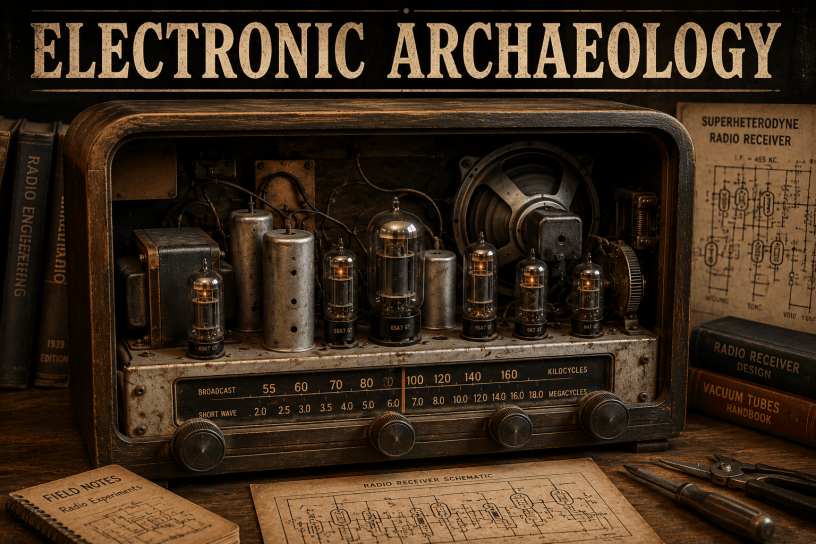
Not by building a radio on the workbench, but by following a radio signal through a complete vacuum tube receiver.
This is the moment where every lesson begins to make sense.
Imagine someone several hundred kilometers away speaking into a microphone at a radio station.
Their voice is converted into an electrical signal.
The transmitter places that signal onto a radio-frequency carrier.
The antenna launches the electromagnetic wave into space.
Seconds later—or more accurately, a tiny fraction of a second later—that signal reaches your antenna.
Now your radio begins its work.
The antenna intercepts an incredibly small amount of the passing radio wave.
The signal is so weak that it cannot operate a loudspeaker.
It must first be processed.
The tuning circuit selects one station from among the thousands filling the air.
Using carefully matched inductors and capacitors, the receiver rejects unwanted frequencies and isolates the one you wish to hear.
In a superheterodyne receiver, the selected signal enters the mixer.
There it combines with the local oscillator.
Together they produce the intermediate frequency we studied last week.
The IF amplifiers strengthen that signal dramatically while preserving the information carried upon it.
Next comes the detector.
The detector removes the radio-frequency carrier, leaving only the original audio.
For the first time since leaving the radio station, the human voice exists by itself once again.
The audio amplifier increases the strength of that signal.
Small voltage changes become powerful enough to move the loudspeaker.
The loudspeaker converts electrical energy into mechanical motion.
Mechanical motion moves the air.
The air reaches your ears.
You hear a voice.
The journey is complete.
Electronic Archaeology Note
One of the things I enjoyed most about electronics was reaching the point where individual components stopped being isolated parts and started becoming systems.
A resistor by itself isn’t very exciting.
Neither is a capacitor or a transformer.
But when each one performs its own small task alongside dozens of others, something remarkable happens.
The whole becomes far greater than the sum of its parts.
That lesson extends well beyond electronics.
Of course, none of this happens without a reliable power supply.
The transformer reduces the incoming line voltage.
The rectifier converts alternating current into direct current.
Filter capacitors smooth the output.
Resistors establish operating voltages.
Every vacuum tube receives exactly the conditions it needs to perform its particular job.
Remove any one of those sections and the receiver stops working correctly.
Every stage depends upon the one before it.
That is the beauty of systems engineering.
No single component deserves all the credit.
The success belongs to the entire design.
By the middle of the twentieth century, engineers had refined this architecture to an extraordinary degree.
Receivers became more sensitive.
More selective.
More reliable.
Some remained in service for decades.
Many continue operating today after careful restoration.
That longevity says something important about the quality of their design.
Electronic Archaeology is not about wishing we still lived in the age of vacuum tubes.
Modern electronics is smaller, faster, more efficient, and more capable than the engineers of the 1940s could have imagined.
But today’s technology rests firmly upon the discoveries they made.
Understanding those discoveries makes modern electronics easier to understand as well.
We have now reached the point where every major lesson from Season One connects together.
You understand the components.
You understand the signal path.
You understand why each stage exists.
There is only one thing left to do.
Build a radio.
Not a complicated vacuum tube receiver.
Not yet.
Next week we will construct one of the simplest and most elegant electronic devices ever invented.
A crystal radio.
It requires no batteries.
No power supply.
No vacuum tubes.
Only a handful of carefully chosen parts.
Yet when connected to a good antenna and ground, it can pull voices and music directly from the air.
There could be no better way to conclude our first season of Electronic Archaeology.
If this work helps you understand what’s happening, help me keep it going: https://www.patreon.com/cw/WPSNews
For more from Cliff Potts, see https://cliffpotts.org
References
Horowitz, P., & Hill, W. (2015). The Art of Electronics (3rd ed.). Cambridge University Press.
Marcus, A., & Marcus, B. (1966). Elements of Radio Servicing. McGraw-Hill.
Encyclopaedia Britannica. (2025). Radio receiver. Encyclopaedia Britannica. https://www.britannica.com/technology/radio-receiver
Discover more from WPS News
Subscribe to get the latest posts sent to your email.

