By Cliff Potts, CSO, and Editor-in-Chief of WPS News
Baybay City, Leyte, Philippines — April 30, 2026
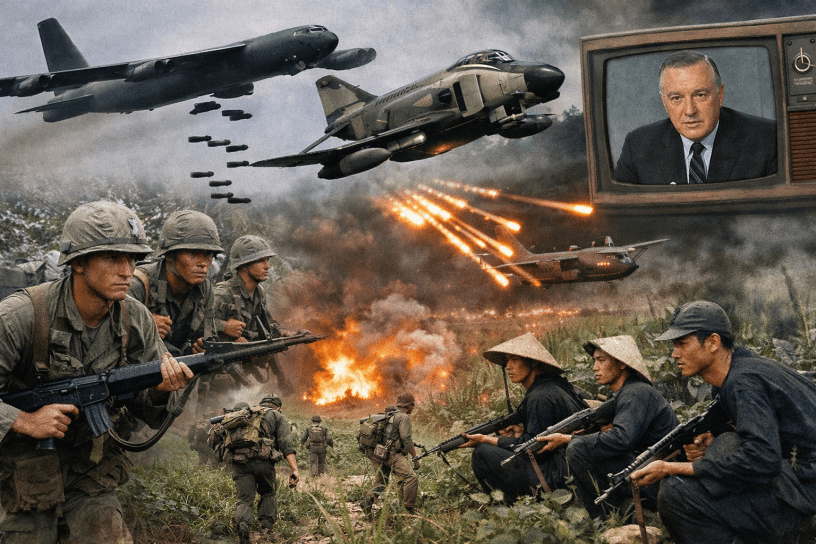
April 30, 2026 marks the 51st anniversary of the Fall of Saigon. On April 30, 1975, at approximately 7:53 a.m. local time, the final U.S. helicopter lifted off from the embassy in Saigon, marking the effective end of American presence in Vietnam and the collapse of South Vietnam. That same moment is also recognized within Vietnam as a point of national reunification—the transition of Saigon into what is now Ho Chi Minh City and the consolidation of Vietnam as a unified state after decades of war.
Early Commitments: From Advisers to Entrapment
The United States did not begin the Vietnam War as a full combatant force. Its involvement emerged gradually from Cold War policy and the aftermath of European colonial conflict.
In the late 1940s and early 1950s, the United States supported France’s effort to retain Indochina, viewing the conflict through the broader strategy of containment (Logevall, 2012). After the French defeat at Dien Bien Phu in 1954, the Geneva Accords temporarily divided the country.
Elections intended to unify Vietnam were never held. Instead, the United States backed South Vietnam and expanded a military advisory presence. By the early 1960s, that advisory mission had deepened into a commitment that would prove difficult to reverse.
LBJ and the Ownership of the War
The transformation into a large-scale war occurred under Lyndon B. Johnson.
Following the Gulf of Tonkin Incident, Congress granted Johnson broad authority to use force. What followed was rapid escalation:
- U.S. Marines landed at Da Nang in 1965
- Troop levels grew to over 500,000
- Sustained bombing campaigns targeted North Vietnam
Johnson did not initiate U.S. involvement, but he made it a full-scale American war.
Privately, Johnson expressed doubt about the conflict, describing it as “the biggest damn mess” he had seen (Goodwin, 1976). By 1968, facing mounting casualties and domestic unrest, he chose not to seek re-election.
A War Fought Without Understanding
Beyond strategy, the war faced a deeper problem: the United States did not understand the environment in which it was fighting.
As documented in The Decline and Fall of the U.S. Army (Cincinnatus, 1976), American forces operated with critical structural disadvantages:
- Most troops did not speak Vietnamese
- Communication depended on interpreters of uncertain reliability
- Units rotated on one-year tours, preventing continuity
This produced operational blindness. Soldiers could move through villages and conduct operations, but often lacked the ability to distinguish allies from enemies in a meaningful way.
The Viet Cong operated within the population, spoke the language, and maintained long-term presence. U.S. forces did not.
Metrics Without Meaning
The U.S. military emphasized attrition—reducing enemy strength through casualties. Under William Westmoreland, success was frequently measured by “body count.”
This created systemic distortions:
- Incentives to inflate enemy casualties
- Difficulty distinguishing civilians from combatants
- Reports of progress disconnected from reality
Westmoreland later argued that U.S. forces “did not lose the war” (Karnow, 1997). The claim reflects battlefield metrics rather than strategic outcome.
In practice, the war’s objectives were not achieved.
The War Reduced to Numbers
The emphasis on body count extended beyond military planning into public reporting.
Nightly television broadcasts frequently presented casualty figures as indicators of progress (Hallin, 1986). The war was reduced to arithmetic: how many were killed, how many operations were conducted, how the numbers compared.
This framing carried consequences:
- It prioritized quantifiable outcomes over strategic reality
- It obscured the political nature of the conflict
- It conditioned the public to equate killing with progress
At the same time, televised reporting increasingly contradicted those numbers. Coverage following the Tet Offensive exposed the limits of official claims.
The gap between reported success and observable reality widened.
Atrocity, Accountability, and the Limits of Control
The strain of the war extended beyond strategy and morale.
The My Lai Massacre became the most widely known example of U.S. forces killing unarmed civilians. William Calley was convicted for his role.
Subsequent reporting indicated that such incidents were not entirely isolated. Investigations into units such as “Tiger Force” documented patterns of abuse in certain operational areas (Turse, 2013).
These actions were not representative of all personnel. However, they reflected conditions within the war:
- Ambiguous identification of enemy forces
- Pressure to produce measurable results
- Weak continuity and oversight in rotating units
My Lai was prosecuted as an exception. It occurred within conditions that made such exceptions possible.
The War at Home: Narrative and Myth
The war was not only fought in Vietnam. It was also interpreted and presented at home.
The film The Green Berets, starring John Wayne, offered a simplified and supportive portrayal of U.S. involvement. The film depicted American forces as clearly justified and the enemy as largely faceless and inhuman.
This portrayal aligned with earlier official narratives but diverged from the increasingly complex and contested reality reported by journalists and experienced by soldiers.
The contrast illustrates a broader divide between narrative and reality.
Nixon and the Managed Withdrawal
When Richard Nixon assumed office in 1969, the war was already deeply entrenched.
His administration pursued “Vietnamization,” shifting combat responsibility to South Vietnamese forces while withdrawing U.S. troops. At the same time, military operations expanded into Cambodia and bombing intensified.
Nixon later wrote that “no event in American history is more misunderstood than the Vietnam War” (Nixon, 1985, p. 9).
The Paris Peace Accords ended direct U.S. involvement in 1973. Fighting continued.
The End—and the Absence
On April 30, 1975, the Fall of Saigon marked both the collapse of South Vietnam and the reunification of the country under a single government.
Johnson did not live to see it. He died on January 22, 1973, days before the peace accords.
He saw escalation and withdrawal—but not the outcome.
Conclusion: A War Beyond Strategy
The Vietnam War lasted roughly two decades. It evolved from advisory support into full-scale conflict and ended in strategic failure for the United States.
Responsibility was shared. Early Cold War decisions set the stage. Johnson escalated the war. Nixon prolonged and concluded it.
But beyond leadership, the war revealed a deeper failure:
The United States committed to a conflict it did not fully understand, measured success in ways that obscured reality, and sustained the war long after its limits were clear.
At the same time, the war’s end marked a beginning for Vietnam—a unified nation that would move forward on its own terms.
Johnson bore the weight of escalation. Nixon managed the exit. Neither saw a successful result.
A Personal Note on Memory and Repetition
When I was in college, I was told—directly and without ambiguity—that my generation was tired of hearing about Vietnam.
The message was clear: the war was over, it belonged to the past, and there was no value in continuing to revisit it.
At that time, the wars that would define the next decades had not yet begun. There was no Iraq War, no Afghanistan War, and even the first Gulf War had not yet taken place.
Vietnam was treated as history that no longer required attention.
I remember being challenged on it—loudly. The frustration was real. Vietnam had been discussed enough. It was time to move on.
That position did not hold.
In the decades that followed, the United States entered prolonged conflicts in Iraq and Afghanistan—wars that repeated many of the same structural problems seen in Vietnam:
- Long-duration commitments without clear end states
- Tactical success that did not translate into strategic victory
- Persistent gaps between official reporting and conditions on the ground
- Limited understanding of local political and cultural realities
The details changed. The pattern did not.
This record is not written for the generation that lived through Vietnam, nor for those who rejected continued discussion of it.
It is written for those who come after.
If the lesson of Vietnam was once dismissed, later conflicts demonstrated the cost of that dismissal. The war ended in 1975. The lessons did not.
Whether those lessons are finally learned may depend on those who are willing to read what others chose to ignore.
For more social commentary, please see Occupy 2.5 at https://Occupy25.com
If you read this and it matters, help me keep it going: https://www.patreon.com/cw/WPSNews
References (APA)
Cincinnatus. (1976). The decline and fall of the U.S. Army. Center of Military History.
Goodwin, D. K. (1976). Lyndon Johnson and the American dream. St. Martin’s Press.
Hallin, D. C. (1986). The “uncensored war”: The media and Vietnam. Oxford University Press.
Karnow, S. (1997). Vietnam: A history (2nd ed.). Penguin Books.
Logevall, F. (2012). Embers of war: The fall of an empire and the making of America’s Vietnam. Random House.
Nixon, R. (1985). No more Vietnams. Arbor House.
Turse, N. (2013). Kill anything that moves: The real American war in Vietnam. Metropolitan Books.
Discover more from WPS News
Subscribe to get the latest posts sent to your email.

