By Cliff Potts, CSO, and Editor-in-Chief of WPS News
Baybay City, Leyte, Philippines — May 5, 2026
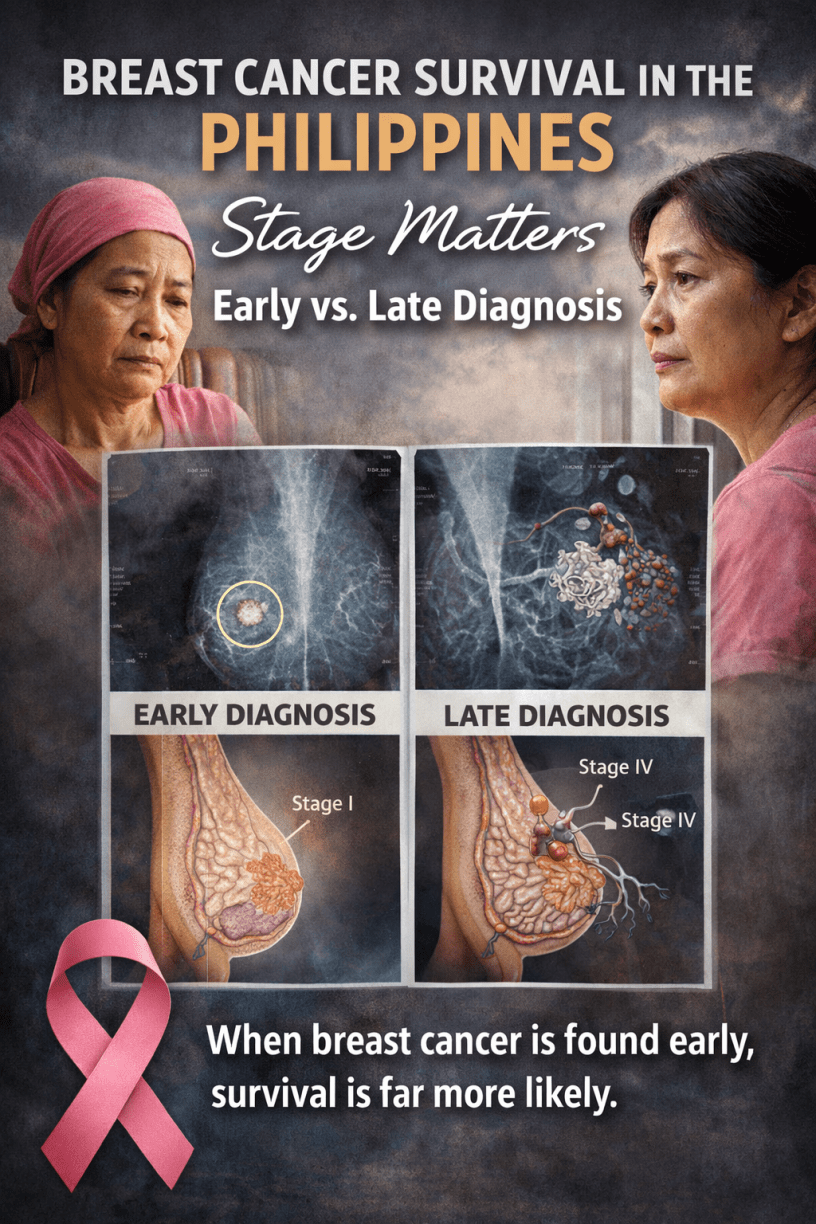
Breast cancer survival is not a mystery. It is not random. In the Philippines, the single strongest factor that determines whether a woman lives or dies from breast cancer is the stage at which the disease is found.
Early-stage breast cancer is often treatable. Late-stage breast cancer is far harder to control. The difference between the two is time—time that is frequently lost because symptoms are subtle, screening is delayed, or access to diagnostic care is limited.
This is not an abstract medical concept. It is the core reality shaping outcomes across the Philippine archipelago.
What “Stage” Really Means
Cancer staging describes how far the disease has progressed. In simple terms, it answers three questions: how large the tumor is, whether cancer has spread to nearby lymph nodes, and whether it has reached other organs.
Early stages—often called Stage I or Stage II—mean the cancer is still localized or only minimally spread. At these stages, treatment options are broader, recovery is more likely, and long-term survival rates are significantly higher.
Later stages—Stage III and especially Stage IV—mean the cancer has spread more extensively. Treatment becomes more aggressive, more expensive, and less predictable. At that point, care often shifts from cure to control.
In the Philippines, too many women first enter the healthcare system at these later stages.
Survival Depends on Timing
International and regional data consistently show that breast cancer detected early has a far higher survival rate than breast cancer detected late. When found early, many women live long, productive lives after treatment. When found late, survival drops sharply.
This gap is not caused by biology alone. It is caused by delayed diagnosis.
Many women do not seek medical care because they feel no pain. Others delay because the lump seems small, because they are busy caring for others, or because they fear the cost of treatment more than the disease itself. Some simply do not have access to screening services close to home.
By the time symptoms become impossible to ignore, the disease has often already advanced.
Common Myths That Delay Care
Several persistent myths contribute to late detection in the Philippines.
One is the belief that breast cancer only affects older women. In reality, Filipino women are often diagnosed at younger ages compared to women in many high-income countries.
Another myth is that a family history is required. While family history increases risk, many women diagnosed with breast cancer have no known genetic link.
There is also the belief that cancer must hurt to be dangerous. Early breast cancer often causes no pain at all. Waiting for pain is waiting for progression.
These beliefs are understandable—but they are costly.
The Cost of Late Diagnosis
Late-stage treatment places enormous strain on families and the healthcare system. It requires longer hospital stays, more complex therapies, and greater financial sacrifice. For many households, the economic impact is devastating.
Early detection does not eliminate hardship, but it significantly reduces it. Treatment is often simpler, outcomes are better, and families retain more control over decisions.
This is why staging matters so much. It is not just a medical label. It is a dividing line between possibility and limitation.
A Preventable Pattern
The high rate of late-stage diagnosis in the Philippines is not inevitable. It reflects gaps in screening access, health education, and early referral pathways. These are solvable problems.
Improving early detection means normalizing screening, reducing fear around diagnosis, and making services accessible beyond major urban centers. It means shifting the national conversation from treatment alone to timing.
Breast cancer does not become deadly overnight. It becomes deadly when it is allowed to grow unnoticed.
Finding it earlier saves lives. That is not hope. It is evidence.
For more social commentary, please see Occupy 2.5 at https://Occupy25.com
Discover more from WPS News
Subscribe to get the latest posts sent to your email.
 WPS News