By Cliff Potts, CSO, and Editor-in-Chief of WPS News
Baybay City, Leyte, Philippines — May 5, 2026
There is a quiet misunderstanding about power in modern organizations. People assume it comes from titles, credentials, or proximity to authority. It does not. It comes from judgment — and, whether we admit it or not, from how that judgment is perceived before a word is spoken.
This is where clothing enters the conversation. Not as fashion. Not as vanity. As signal.
A Chief Strategy Officer does not need to dress like an executive from a corporate brochure. In fact, doing so often has the opposite effect. The polished, over-fitted, high-gloss look suggests performance. Strategy is not performance. Strategy is restraint.
The goal is not to impress. The goal is to remove friction.
Most days, especially in a place like the Philippines, the correct answer is simple: a clean shirt, practical trousers or shorts, and shoes that do not cause pain. This is not a failure of professionalism. It is an understanding of environment. Heat, humidity, and local norms matter. Anyone pretending otherwise is signaling something — but it is not competence.
The mistake many foreigners make is overcorrection. They arrive and attempt to assert credibility through clothing. The result is predictable. They stand out, but not in a useful way. They become visible rather than credible.
A strategic operator understands context.
There are, however, moments when the environment changes. A meeting, a formal discussion, a situation where decisions are being shaped rather than observed. In those moments, clothing becomes a tool.
The correct tool is not complicated.
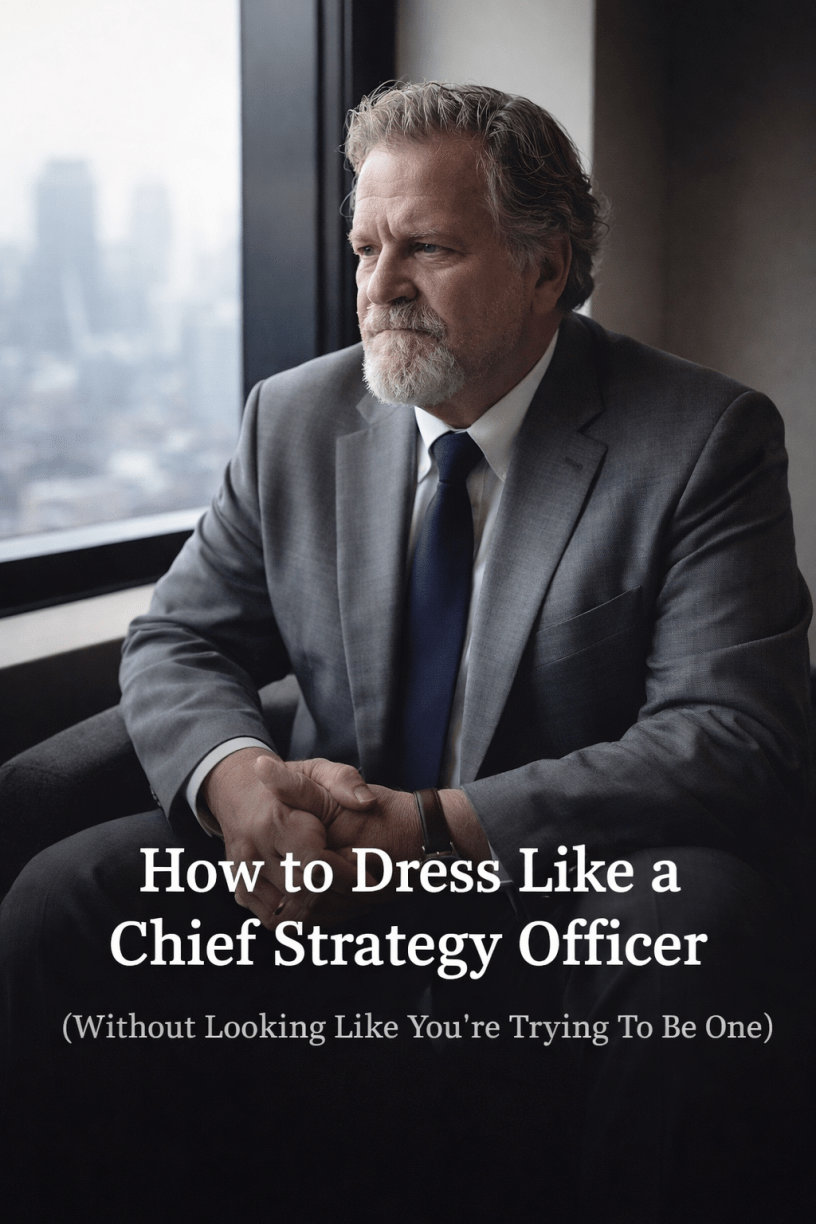
A single, well-fitted gray suit — not flashy, not slim, not theatrical. A plain shirt. A tie, if needed, in navy or a muted burgundy. Shoes that are conservative and comfortable. Nothing more.
This is not about looking powerful. It is about looking settled.
There is a difference.
Power seeks attention. Settlement does not. Settlement assumes it.
Optional elements exist, but they must be controlled. A vest, if it disappears into the suit. A simple watch that tells time without announcing its price. Even a hat, if worn as a matter of habit rather than statement. Each addition must pass a single test: does it draw attention, or does it dissolve into the whole?
If it draws attention, it fails.
This is why certain stylistic impulses — the bright seersucker suit, the aggressive tailoring, the visible luxury — are best avoided. They are not wrong in isolation. They are wrong in context. They turn the wearer into the subject, when the subject should be the decision.
There is, of course, a degree of humor in all of this. The idea that one can “dress like” a Chief Strategy Officer is inherently flawed. No suit grants judgment. No tie creates foresight. The uniform does not make the role.
But it can undermine it.
And that is the point.
The correct approach is not to build a wardrobe that announces status. It is to build one that never contradicts it. Clothing should be quiet enough that it disappears, leaving only the thinking behind it.
If there is a single principle to take from this, it is this: dress in a way that allows people to focus on what you are saying, not what you are wearing.
Anything more is noise.
For more social commentary, please see Occupy 2.5 at https://Occupy25.com
If this work helps you understand what’s happening, help me keep it going: https://www.patreon.com/cw/WPSNews
Discover more from WPS News
Subscribe to get the latest posts sent to your email.
 WPS News