By Cliff Potts, CSO, and Editor-in-Chief of WPS News
Baybay City, Leyte, Philippines — June 4, 2026
The China Question That Distorts the Conversation
Any serious discussion of TikTok eventually collides with the same issue: ownership.
A large portion of the criticism directed at TikTok is not rooted in unique behavior, but in the fact that it is a Chinese-owned company. That reality distorts the conversation and often obscures more than it reveals.
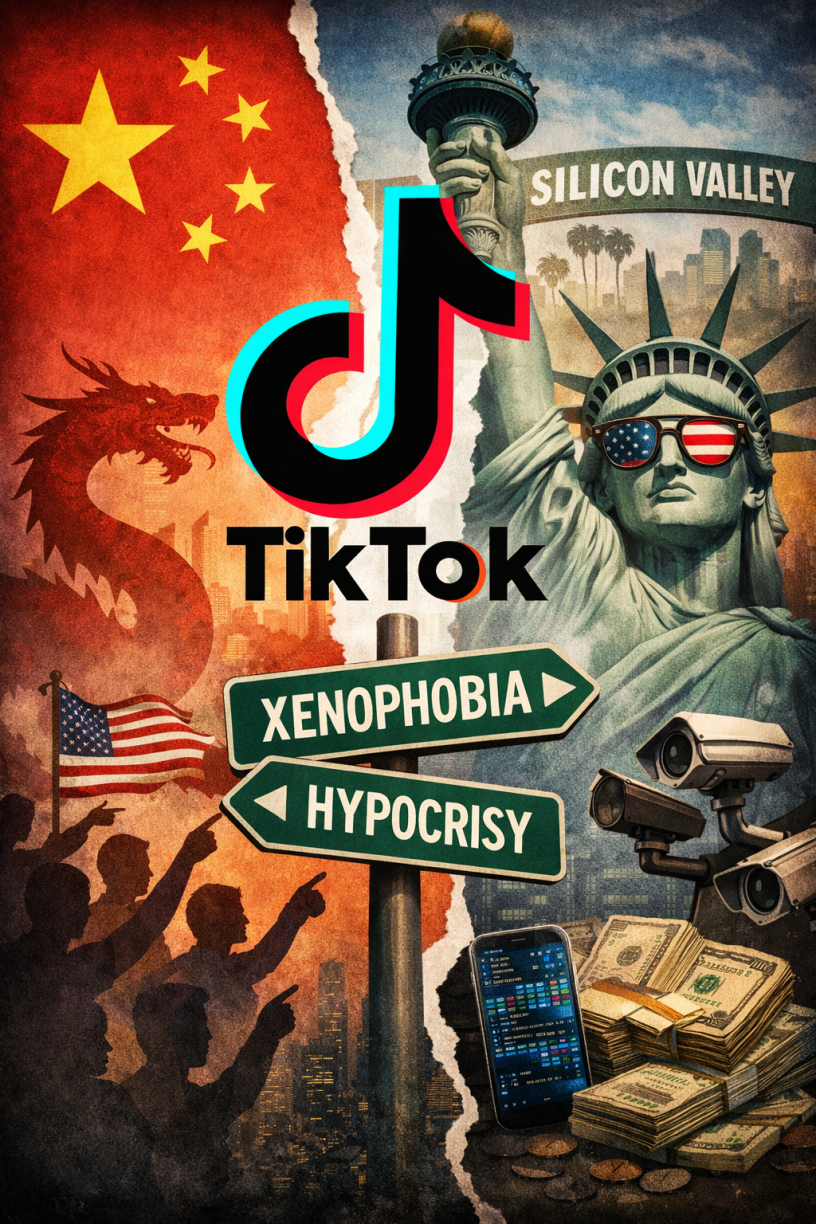
This matters, because there is little that TikTok does—structurally, technically, or commercially—that is not already standard practice among major U.S.-based social media platforms. Opaque algorithms, inconsistent moderation, aggressive data extraction, and monetization pressure are not Chinese inventions. They are core features of modern platform capitalism (Gillespie, 2018; Srnicek, 2017; Zuboff, 2019).
Same Playbook, Different Accent
The real distinction between TikTok and its Silicon Valley counterparts is not intent, but polish.
American technology firms have had decades to refine how they obscure harm. Their language is smoother. Their legal defenses are rehearsed. Their apologies are calibrated. Their regulatory theater is well practiced (Pasquale, 2015).
TikTok is clumsier. Its governance failures are more visible. Its contradictions are less artfully concealed. That difference is often misinterpreted as evidence of uniquely malicious intent, when it more plausibly reflects relative inexperience operating within an already exploitative system.
Given enough time, TikTok is likely to become just as adept at hiding harm as its Western peers. That outcome would not represent progress. It would represent convergence.
When Criticism Slides Into Bigotry
It is impossible to ignore that some hostility toward TikTok is cultural rather than analytical.
Anti-Chinese sentiment in the United States has deep roots, particularly in California, where Chinese labor was once essential to economic development and simultaneously treated as a social threat. Exclusionary laws, racialized suspicion, and economic scapegoating formed a durable pattern that has never fully disappeared (Lee, 2015; Takaki, 1998).
When identical platform behaviors are tolerated from U.S. firms but framed as existential danger when practiced by a Chinese one, the issue is no longer governance. It is bias.
This selective outrage does not protect users. It distorts accountability.
Silicon Valley’s Convenient Blind Spot
Silicon Valley presents itself as global and diverse, but its tolerance is uneven.
Executives from many parts of the world are embraced when they align with corporate interests. Chinese firms, however, are rarely granted the same presumption of legitimacy. Instead, they are often treated as proxies for an entire nation-state, regardless of evidence or operational reality (DeNardis, 2014; Mueller, 2017).
That framing allows American platforms to escape scrutiny by comparison. It also allows policymakers to focus on nationality rather than structure—an approach that leaves the underlying problems intact.
Criticism That Actually Matters
None of this excuses TikTok’s failures.
Governance chaos, incoherent moderation, and unstable commercial practices remain real problems that deserve sustained scrutiny. But criticism grounded in xenophobia weakens that scrutiny. It allows TikTok to dismiss legitimate concerns as political theater while U.S.-based platforms continue identical practices with less resistance.
If accountability is the goal, the standard must be consistent.
Holding Two Truths at Once
Two truths can and must coexist:
TikTok exhibits serious governance failures that undermine trust and commerce.
And a meaningful portion of the outrage directed at TikTok is amplified by long-standing anti-Chinese bias rather than principled concern for users.
Failing to acknowledge the second truth undermines the first.
Until Silicon Valley confronts the behavior it has normalized at home, its criticism of foreign platforms will remain compromised.
For more social commentary and excellent fiction, see Occupy 2.5 at https://Occupy25.com
This essay will be archived to the WPS News Monthly Brief available through Amazon.
APA Citations:
DeNardis, L. (2014). The global war for internet governance. Yale University Press.
Gillespie, T. (2018). Custodians of the internet: Platforms, content moderation, and the hidden decisions that shape social media. Yale University Press.
Lee, E. (2015). The making of Asian America: A history. Simon & Schuster.
Mueller, M. (2017). Will the internet fragment? Polity Press.
Pasquale, F. (2015). The black box society: The secret algorithms that control money and information. Harvard University Press.
Srnicek, N. (2017). Platform capitalism. Polity Press.
Takaki, R. (1998). Strangers from a different shore: A history of Asian Americans. Little, Brown.
Zuboff, S. (2019). The age of surveillance capitalism. PublicAffairs.
Discover more from WPS News
Subscribe to get the latest posts sent to your email.

