By Cliff Potts, Editor-in-Chief, WPS News
September 6, 2026 — Baybay City, Leyte, Philippines
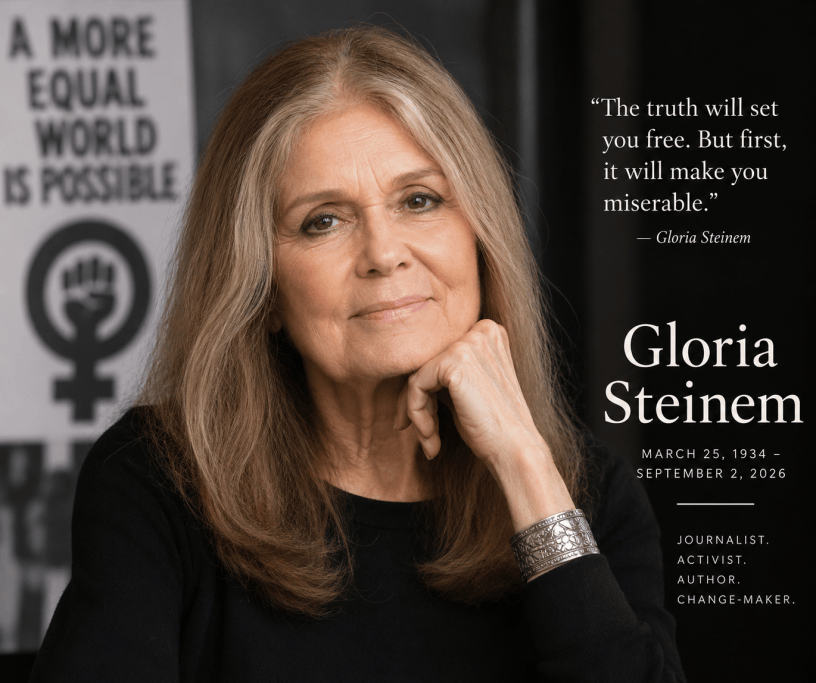
Gloria Steinem died September 2 at her home in New York City. She was 92.
For more than half a century, Steinem was one of the most recognizable voices of American feminism: journalist, organizer, author, political activist, co-founder of Ms. magazine and a woman who spent much of her adult life insisting that equality was not some radical concession society might someday grant women. It was their right.
Three days after her death, there is an obvious temptation to simply declare victory for a life well lived.
The harder question is whether she won.
She Found Her Cause
Steinem was born March 25, 1934, in Toledo, Ohio. After graduating from Smith College, she entered journalism at a time when women working in the profession routinely encountered barriers their male colleagues did not.
Her breakthrough came in 1963 when she went undercover as a Playboy Bunny and documented the working conditions inside New York’s Playboy Club. But Steinem’s transformation from journalist into activist accelerated after she attended a 1969 gathering where women publicly discussed their experiences obtaining abortions, then illegal in much of the United States.
Steinem had herself undergone an abortion after college, something she had kept secret because of the stigma surrounding it.
She increasingly recognized that what individual women had been taught to regard as private failures were often consequences of political and economic structures.
That realization became central to the women’s movement.
In 1971, Steinem helped establish the National Women’s Political Caucus. That same year she helped launch Ms. magazine, initially appearing as an insert in New York magazine before becoming an independent publication in 1972.
Ms. discussed subjects mainstream publications often avoided or marginalized: abortion, domestic violence, workplace discrimination, sexual harassment and women’s political power.
Putting those subjects into print mattered because naming a problem is frequently the first step toward making society acknowledge that the problem exists.
Did Any of It Work?
This is where an obituary should resist mythology.
Gloria Steinem did not liberate American women single-handedly. No individual did. The women’s movement consisted of millions of women and men, organizers, lawyers, politicians, writers and ordinary people whose names will never appear in history books.
Steinem understood that herself.
But did the movement she helped build accomplish anything?
Absolutely.
The America in which Steinem began her career was a country where women could encounter legal and institutional obstacles to obtaining credit independently, where employment discrimination was commonplace, where sexual harassment was barely recognized as a public issue and where domestic violence was frequently treated as something occurring behind somebody else’s closed door.
Women entered universities, professions, politics and positions of economic independence in numbers previous generations could scarcely have imagined.
Steinem didn’t accomplish all that.
But she helped create the political language, organizations and public pressure that made those changes possible.
That is an enormous legacy.
And Yet, Here We Are
There is another side to the story.
The constitutional Equal Rights Amendment Steinem championed never became part of the Constitution. In 2022, the Supreme Court overturned Roe v. Wade, eliminating the federal constitutional protection for abortion that had existed for nearly half a century. Steinem, then 88, responded by insisting the struggle for reproductive freedom would continue.
And at street level, it can sometimes seem as though some of the cultural assumptions Steinem spent decades fighting never really disappeared.
Perhaps they didn’t.
Rights can be won without prejudices disappearing. Laws can change faster than cultures. And political victories that appear permanent to one generation can be challenged by the next.
That doesn’t mean the earlier struggle failed.
It means there was never a finish line.
The Measure of a Life
Steinem received the Presidential Medal of Freedom from President Barack Obama in 2013. She remained politically active well into old age, continuing to write, organize and advocate for women’s rights.
Her final memoir, An Unexpected Life, is scheduled for posthumous publication this month.
But medals, books and famous photographs aren’t the most convincing measure of what Gloria Steinem accomplished.
A better measure may be how unremarkable some freedoms now seem.
A woman opening her own credit account. A woman expecting equal consideration for a job. A woman running for president. A woman publicly identifying sexual harassment instead of being expected to quietly tolerate it. A battered woman being treated as the victim of a crime rather than the participant in a private family dispute.
None of those things is remarkable enough anymore.
That is precisely the point.
Social movements sometimes succeed so thoroughly that later generations forget how abnormal today’s normal once was.
Gloria Steinem found herself a cause and gave most of her life to it.
Did she change everything?
No.
Did everything she fought for survive?
No.
Are some of those fights being fought all over again?
Absolutely.
But did Gloria Steinem and the movement she helped build change the world?
Yes.
The evidence is all around us — including in the freedoms now taken so much for granted that people can forget somebody once had to fight for them.
Gloria Steinem did.
And she kept fighting almost to the end.
References
Associated Press. (2026, September 3). Gloria Steinem, defining symbol of women’s movement and eloquent advocate for equality, dies at 92.
Reaney, P. (2026, September 3). Feminist activist Gloria Steinem dies at age 92. Reuters.
The Washington Post. (2026, September 3). Gloria Steinem, lodestar of the modern women’s movement, dies at 92.
Discover more from WPS News
Subscribe to get the latest posts sent to your email.

