By Cliff Potts
Baybay City, Leyte, Philippines — September 7, 2026 — 07:05 AM PhST
After the Cost, the Choice
We’ve already talked about what this costs.
Not in dollars. In people.
Apollo 1. Soyuz 1. Challenger. Columbia.
We do not move forward in space without carrying that weight with us.
So the question now is simple.
What are we going to do with it?
Because remembering is not enough.
Side Note: This Does Not End Here
There is something else that needs to be said plainly.
This series was planned as twelve essays.
It may not stop there.
Because Artemis may not stop there.
If the first landing works, there will be another mission. And another. And another. That is the point. This is not a one-time return. This is the beginning of a continuous presence beyond Earth.
We have been down this road before.
We reached the Moon, and then we walked away.
That is not happening again.
Not this time.
Not quietly.
Not without being noticed.
This project will continue as long as the missions continue. If Artemis becomes a program that builds, expands, and moves forward, then this coverage will do the same.
Because stopping the story is how you normalize stopping the mission.
And that is not acceptable.
Not on my watch.
This is WPS News. We don’t drop the story.
The Gap Between Orbit and Ground
We can reach the Moon.
We proved that again with Artemis II.
We can send a crew out, loop around the Moon, and bring them home safely. That part of the system is real now, not theoretical (NASA, 2025).
But there is a gap.
A very real one.
Getting to lunar orbit is not the same as landing.
And right now, that gap is the most fragile part of the entire mission.
What a Lander Has to Do
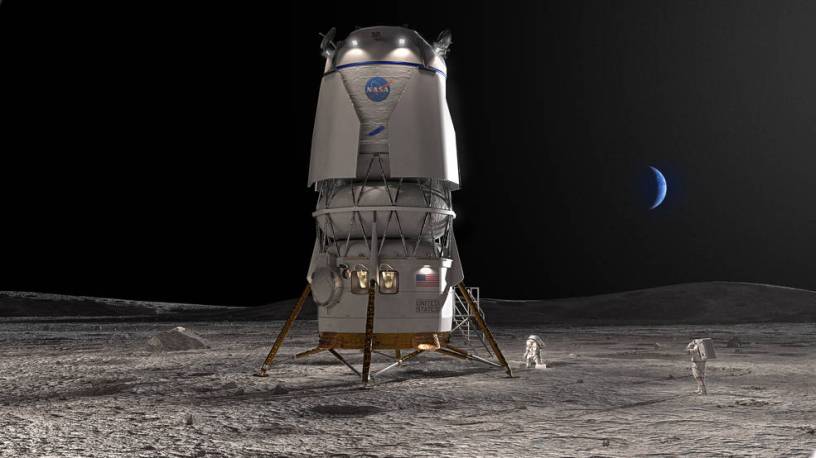
A lunar lander is not just a vehicle.
It is a chain of responsibilities.
It must:
- Receive a crew in lunar orbit
- Descend safely to the surface
- Operate in extreme conditions
- Support human activity on the ground
- Launch back off the Moon
- Return to orbit and reconnect with the crew vehicle
Every one of those steps has to work.
Not in isolation.
In sequence.
Failure at any point ends the mission.
This Is Not Apollo
It is tempting to think we have already solved this problem.
We landed on the Moon before.
We know how to do it.
That is only partially true.
Apollo missions targeted relatively flat, equatorial regions and were designed for short stays with minimal equipment. The systems were optimized for speed and simplicity (NASA, 1971).
Artemis is aiming somewhere else entirely.
The south pole.
Rough terrain. Long shadows. Extreme temperature variation. Limited direct sunlight.
And potentially, water ice.
That changes everything.
Because this is not about touching the surface.
This is about beginning to operate there.
The South Pole Changes the Mission
Water is the difference.
Water supports life.
Water can be converted into fuel.
Water allows for longer stays, repeated missions, and eventually infrastructure.
But the regions where water is likely to exist are among the most difficult places to land.
Which means the lander is not just a vehicle.
It is the key to whether Artemis becomes a sustained effort or another short visit.
The Reality Check
Here is the part that cannot be ignored.
The lander is the least proven element of the Artemis architecture.
We have proven the rocket.
We have proven the crew vehicle.
We have not yet proven the full system that gets humans down to the surface and back up again under Artemis conditions.
That does not mean it will fail.
It means it is the part that requires the most attention, the most testing, and the most patience.
The Cost Argument, Again
There will be people who look at this and ask why we are investing time and resources into something this complex.
The answer has not changed.
We have heard this before.
We paused exploration once, believing that stopping would allow us to solve problems on Earth.
Those problems remained.
What changed was our willingness to attempt difficult things.
NASA’s budget remains a small fraction of overall government spending (Office of Management and Budget, 2025). This effort does not prevent us from addressing issues on Earth.
It reflects whether we are willing to do more than one thing at a time.
A System That Decides the Future
The lander determines what Artemis becomes.
If it works, the Moon becomes accessible again.
Not once.
Repeatedly.
If it does not, the mission stops in orbit.
Close enough to see the surface.
Not close enough to reach it.
Where We Stand
We have already returned to the Moon’s vicinity.
We have already proven we can get there.
Now we are working on the part that actually completes the journey.
Down.
And back up again.
The Choice, Again
We have stood at this point before.
Within reach.
Capable.
And unsure whether to continue.
The difference this time is awareness.
We know what happens when we stop.
We know what is lost when we decide that forward motion is optional.
Closing
The lander is the missing piece.
The step between reaching the Moon and standing on it.
And once that step is taken, everything changes.
We’re still going back.
References
National Aeronautics and Space Administration. (1971). Apollo 15 mission report. NASA.
National Aeronautics and Space Administration. (2025). Artemis II mission results and objectives. https://www.nasa.gov/artemis-ii
Office of Management and Budget. (2025). Historical tables: Budget of the U.S. government. https://www.whitehouse.gov/omb
If this work helps you understand what’s happening, help me keep it going: https://www.patreon.com/cw/WPSNews
For more from Cliff Potts, see https://cliffpotts.org
Discover more from WPS News
Subscribe to get the latest posts sent to your email.

