By Cliff Potts, Editor-in-chief, WPS News
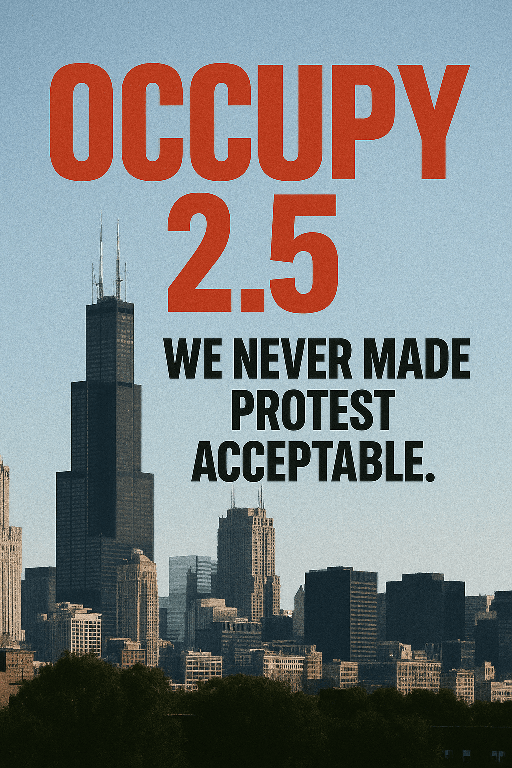
On an unseasonably hot spring day in May 2012, a crowd of defiantly hopeful protesters marched through Chicago’s streets, chanting beneath the glow of skyscrapers. They were Occupy Chicago, the local front of a nationwide uprising against inequality. Their banners decried corporate greed and their voices echoed with demands for change. As world leaders converged for a NATO summit blocks away, these demonstrators—thousands strong—seized their moment to speak truth to power.
But inside City Hall’s marbled corridors, Mayor Rahm Emanuel and his operatives were already crafting a very different response. What began as a spontaneous citizens’ movement would soon collide with classic Chicago power politics—a clash of idealism versus “the Chicago Way.” Over the next two years, Occupy’s open-air assemblies would be supplanted by stage-managed “optics,” as a new entity called Chicago Rising emerged amid claims that City Hall had co-opted and defanged the resistance.
This is the story of how a resurgent protest culture that had once shaken the Windy City’s establishment was gradually repackaged—and how the core of Occupy Chicago was arguably usurped by Emanuel’s City Hall machine, in ways that raise serious questions about democracy, corruption, and the right to protest in Chicago.
City Hall vs. the Occupiers: Crackdown at #NoNATO
From the start, Emanuel treated Occupy Chicago less like constituents exercising First Amendment rights and more like a threat to be contained. In fall 2011, as Occupy encampments spread nationwide, Chicago stood out for its zero-tolerance stance: 175 peaceful demonstrators were arrested in one night for attempting an encampment in Grant Park. That was merely a prelude.
Anticipating major protests during the May 2012 G8/NATO summits, Emanuel pushed through sweeping new municipal ordinances that dramatically expanded his police powers and imposed “permanent new limitations on political dissent.” Under the pretext of summit security, the mayor won authority to deputize federal agents as local police and tightened rules on everything from public assembly permits to parade fees.
Civil libertarians blasted these measures—passed hastily by the City Council—as an outright attempt to “outlaw dissent” in Chicago. Emanuel’s own former law school colleague, Professor Bernard Harcourt, accused him of exploiting a manufactured crisis to increase surveillance and make protest restrictions permanent. It was as if City Hall had dusted off an old playbook from Chicago’s machine politics era: use any means necessary to keep unruly voices in line.
Those draconian rules set the stage for the NATO summit showdown. In May 2012, tens of thousands of activists—union members, anti-war veterans, nurses, students, anarchists—flooded downtown under the #NoNATO banner. Marchers ringed President Obama’s campaign headquarters and even picketed outside Mayor Emanuel’s own home, a personal rebuke to Chicago’s leader.
The city’s response was a heavy police mobilization on a scale not seen in decades. Heavily armored officers and riot units corralled protesters into “free speech” zones. Behind the scenes, Emanuel’s police brass had embedded undercover operatives in the movement’s midst. In an episode now infamous among Chicago activists, two young police infiltrators known by the handles “Mo” and “Gloves” spent weeks posing as hardcore occupiers—only to help engineer the arrests of a small group of protesters on trumped-up terrorism charges.
Dubbed the “NATO 3,” those arrestees were accused of an outlandish plot to firebomb targets including police stations, Obama’s headquarters, and Emanuel’s home. Prosecutors painted them as dangerous black-clad anarchists; yet defense attorneys later revealed that the Molotov cocktails at issue were actually constructed under the direction of the undercover cops, who had egged on the idea. In court, the NATO 3’s lawyer flatly accused Chicago police of entrapment, saying officers “infiltrated the group and [encouraged] the bomb-making effort.” He even alleged that evidence was planted during the raid.
(For the record, a jury would acquit the trio of all terrorism charges, convicting them only on lesser counts.)
Emanuel, however, defended the aggressive tactics. Police Superintendent Garry McCarthy crowed that taking down the activists was necessary to prevent an “imminent threat,” and State’s Attorney Anita Alvarez proudly noted it was the first-ever use of Illinois’ anti-terror statutes against social activists.
To veteran civil rights observers, the episode was chilling: the mayor of Chicago appeared willing to bend laws and manufacture fear to crush a movement, trampling the right to assemble and petition government—the very core of the First Amendment.
Rebranding the Revolution: The Rise of Chicago Rising
After the NATO protest crackdown, many in Occupy Chicago were understandably rattled. While the official encampment never took root, the spirit of resistance lived on. The brutal clash of 2012 served as both a wake-up call and a training ground for the next generation of organizers.
In 2013, as Mayor Emanuel pushed to close 54 public schools—mostly in Black and Latino neighborhoods—Chicago saw a “resurgent protest culture” rise to challenge him. Teachers, parents, and students marched in the streets, chanting “We need the money that Rahm took!”
That same year, Occupy Chicago quietly rebranded itself as Chicago Rising. The Facebook page was renamed. The Twitter handle changed. The rhetoric softened. What had been a loud and chaotic civic uprising was now a coalition-based social media amplifier.
Gone were the calls for mass direct action. In their place: petitions, permitted marches, and carefully staged visuals. The edge of Occupy had been sanded down.
Nobody could say exactly who orchestrated the change. But many of the same players who once led marches were now working in NGOs, unions, and advocacy groups that Emanuel preferred negotiating with. What had once been a danger to City Hall had now been absorbed by it.
The Chi-Town Rising Irony
In 2015, Rahm Emanuel’s allies unveiled Chi-Town Rising, a glitzy New Year’s Eve festival with fireworks, TV cameras, and a symbolic star rising over the Chicago River. It wasn’t just a PR stunt—it was a slap in the face.
The phrase “Chicago Rising”, born in the streets, was now being sold back to the public as branded optimism—with a $90 ticket price. Police barricades blocked access to “public” space. The poor were priced out of the celebration.
What began as a cry for justice had become a marketing slogan.
Verdict and Legacy
In the end, this is a cautionary tale: how movements die not just from repression, but from absorption.
The true Chicago Rising—born of rage, hope, and democratic hunger—was hijacked. The players are named: Rahm Emanuel, Garry McCarthy, Anita Alvarez, Nadia Chikko, Mehmet Uygun, and others who enforced the crackdown.
But so too are the nameless: the occupiers, medics, students, and neighbors who once believed that protest could mean something in Chicago.
The next time the city rises, the machine may not be able to catch it in time.
Full APA Citation List for
“The Great Hijack: How Rahm Emanuel and Chicago City Hall Gutted the Protest Legacy of Occupy”
Ammons, S. (2015, January 1). Chi-Town Rising for the 1%: How Rahm’s New Year’s Bash Sums Up Chicago’s Inequality. Truthout.
https://truthout.org/articles/chi-town-rising-for-the-1/
Associated Press. (2014, October 10). Occupy Chicago marks 3-year anniversary. WLS-TV.
https://abc7chicago.com/archive/9720810/
BBC News. (2012, May 21). Nato summit: Protesters march in Chicago.
https://www.bbc.com/news/world-us-canada-18143120
Bishara, H. (2015, April 30). Chicago Rising Protest at NFL Draft Town Draws No One. NBC Chicago.
https://www.nbcchicago.com/news/local/chicago-rising-protest-at-nfl-draft-town-draws-no-one/112460/
City of Chicago. (2012, January 18). Mayor Emanuel Introduces Ordinance to Address Public Safety During Upcoming G8/NATO Events. [Press release].
https://www.chicago.gov
Davey, M. (2012, May 20). Thousands Protest NATO in Chicago. The New York Times.
https://www.nytimes.com/2012/05/21/us/thousands-protest-nato-in-chicago.html
Huff, R. (2015, December 28). NBC’s ‘Chi-Town Rising’ Preps for a Big New Year’s Bash. Variety.
https://variety.com/2015/tv/news/nbc-chi-town-rising-new-years-1201668432/
Lydersen, K. (2013, October 24). Chicago Protesters Target Mayor Emanuel’s School Closings and Police Violence. In These Times.
https://inthesetimes.com/article/chicago-protesters-target-emanuel-over-school-closings-police-violence
Meisner, J. (2014, February 10). NATO 3 convicted of mob action, not terrorism. Chicago Tribune.
https://www.chicagotribune.com/news/ct-met-nato3-verdict-20140208-story.html
Perlstein, R. (2013, June 7). The City That Shrugged. The Nation.
https://www.thenation.com/article/archive/city-shrugged/
Steinberg, N. (2012, May 16). NATO Protest Rules: Legal or Not? Chicago Sun-Times.
https://chicago.suntimes.com/2012/5/16/18476952/nato-protest-rules-legal-or-not
Warren, J. (2014, November 24). Occupy Movement Quieted, but Impact Still Reverberates. Al Jazeera America.
http://america.aljazeera.com/articles/2014/11/24/occupy-movementquietedbutimpactstillreverberates.html
Wernick, A. (2015, November 25). Chicago protests erupt after video of police killing of black teen released. PRI’s The World.
https://theworld.org/stories/2015-11-25/chicago-protests-erupt-after-video-police-killing-black-teen-released
Zorn, E. (2012, May 25). The NATO 3 and the Trouble with ‘Terror’ Charges. Chicago Tribune.
https://www.chicagotribune.com/columns/eric-zorn/ct-xpm-2012-05-25-chi-zorn-nato-terror-20120525-column.html
📌 Additional Archival Sources
- Occupy Chicago social media archives (2012–2014), including Facebook page transition to “Chicago Rising”
- Archived livestreams and reports from #NoNATO 2012 coverage on YouTube, Livestream.com, and independent media outlets
- Legal filings in People v. Church et al. (NATO 3 case), Cook County, IL
- Testimony from defense attorney Michael Deutsch and statements by CPD Superintendent Garry McCarthy (court records and press interviews)
Discover more from WPS News
Subscribe to get the latest posts sent to your email.
 WPS News