By Cliff Potts, CSO, and Editor-in-Chief of WPS News
Baybay City, Leyte, Philippines — September 28, 2026
There is a corner in Chicago where I’ve never stood when it mattered.
Belden and Central Park. Early 1920s. My mother walked out of a house there in 1922 at five years old, speaking Polish, heading into a world that had no use for it. That was the year she started school. That was the year the transition began.
Inside the house, she lived in one country. Outside, she entered another.
Her father had already made one hard decision before she was born, leaving Poland to avoid serving in the czar’s army. That was not ideology. That was survival. Her mother, second-generation Polish-American, stood between two worlds that never fully merged. The result was a household that carried memory forward, even as it was being replaced.
My mother stepped out the door speaking Polish. She walked into a classroom that functionally required English. There was no easing into it. No transition period. Children adapted because they had to. In doing so, they began losing something at the same time.
By the end of her life, my mother could still read Polish, sounding out the words from old letters. But she could no longer speak it. That loss did not happen suddenly. It started the day she walked into school.
The neighborhood itself was not poor in the way people think of poverty now. It was stable enough. Working families. Brick two-flats and three-flats. People lived close together, physically and culturally. Multiple languages existed on the same block. English was not always the dominant one.
Daily life was structured around work. Physical work. Immediate work. If your body worked, you worked. If your job disappeared, there was no transition waiting for you.
My grandfather delivered milk by horse. The horse knew the route. Sometimes better than he did. And sometimes, when it decided the day was over, it went back to the barn on its own, wagon still partially full.
That part sounds almost funny until you understand what came next.
When the trucks came, the job did not evolve.
It ended.
He did not know how to drive one. There was no system in place to teach him. One day, he had a skill that mattered. Then the world changed, and it didn’t.
That pattern did not end with him.
A century later, I lived through the same thing. Different tools. Same outcome. A skill that fed you one year, discarded the next. The system moves. People either keep up instantly or they are left behind.
The tools changed. The outcome did not.
Horse to truck. Network to network. Worker to obsolete.
Chicago in 1922 was not a finished city. It had edges. You could feel where it stopped.
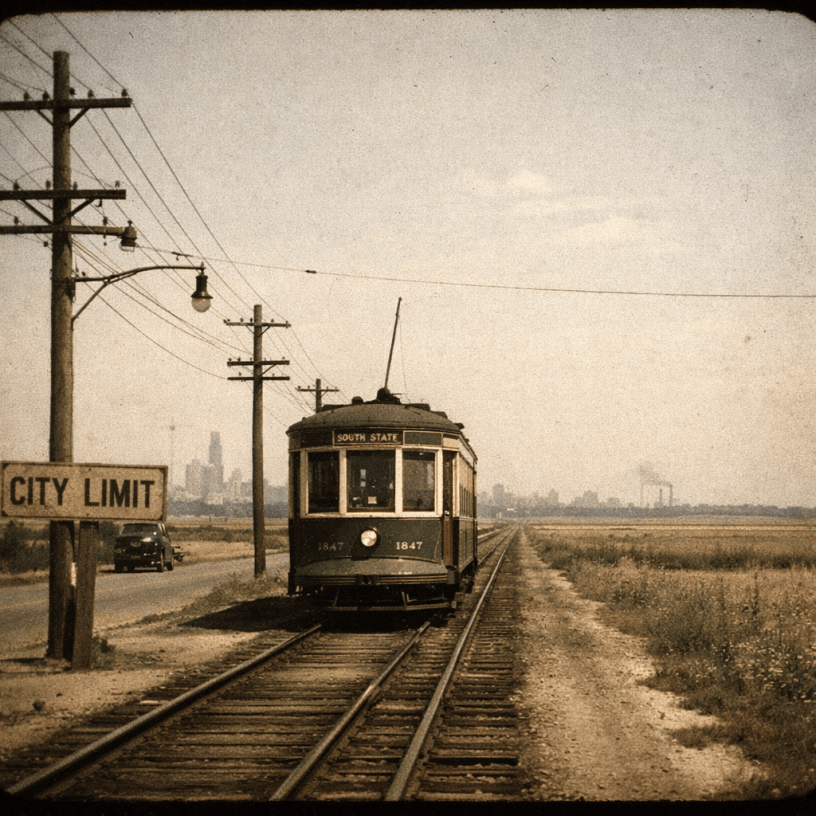
My mother remembered the streetcars. Car fare was a nickel. You dropped it in, and the city opened up to you. Neighborhood to neighborhood, language to language, block to block.
If she stayed close to home, that meant streets like Fullerton, part of the everyday movement of the neighborhood.
But when the destination mattered, when the trip carried weight, the route changed.
To reach the cemetery, the ride ran northwest along Milwaukee Avenue.
And if you rode far enough in that direction, the city thinned out.
Buildings gave way to open land. Streets gave way to space. What stands today around Milwaukee and Devon was farmland when she was a child. Not metaphorically. Literally.
That is where my family was laid to rest.
At St. Adalbert Catholic Cemetery in Niles, my family was buried. Polish Catholic, tied to the same community that shaped their lives. Not scattered. Not separated. Together.
My grandmother is there. The child she lost is there. My grandfather followed later, buried in the same general ground. Around them are relatives, some of whom had done better financially and secured larger plots. Those plots became shared family ground. Over time, it became a cluster.
Ten people, maybe more. All family. All connected.
In life, there were differences. Money, status, opportunity.
In death, those lines blurred.
They ended up together.
That is something we do not really build anymore.
They did not have much security in life. Work could disappear. Illness could take you. Language could fade within a generation.
But they had one certainty we have mostly lost.
When it was over, they knew where they were going.
They would be buried among their own.
Death had cost, but it had not yet become the kind of industry it is now. It had not yet been itemized into invoices and packages and tiers of service. The land had already been claimed. The place already secured.
You did not have to negotiate your way into your final resting place.
You belonged there.
That kind of certainty is difficult to imagine now.
Not because it was comforting. Life was harder, riskier, and shorter.
But because it was fixed.
The world could change around you. And it did.
But at the end of it, there was a place that did not move.
My mother rode a nickel streetcar out of a crowded Polish neighborhood, along Milwaukee Avenue, past where the city stopped and the farmland began, to visit family buried at St. Adalbert.
That ride was not just distance.
It was transition.
From language to language. From old world to new. From life to memory.
We like to think of history as something distant. Something separate.
It isn’t.
It is a series of people adapting to change they did not control, holding on to what they could, and leaving behind what they could not carry.
Some of that is lost.
Some of it ends up in places like St. Adalbert, carved into stone.
And some of it survives because someone remembers enough to write it down.
If this work helps you understand what’s happening, help me keep it going: https://www.patreon.com/cw/WPSNews
For more from Cliff Potts, see https://cliffpotts.org
Discover more from WPS News
Subscribe to get the latest posts sent to your email.

