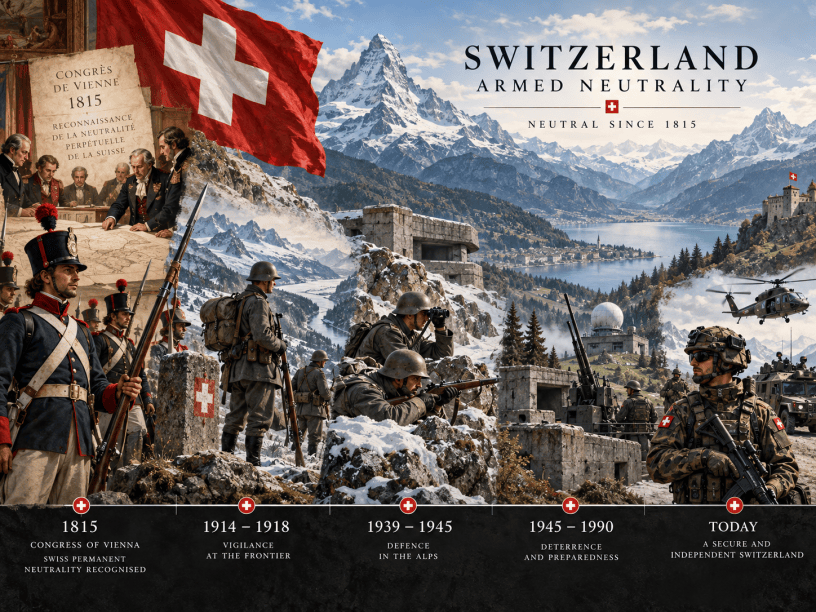
Russia’s War Is Forcing the Swiss to Decide What Neutrality Means
By Cliff Potts, Editor-in-Chief, WPS News
BAYBAY CITY, LEYTE, Philippines — Monday, September 28, 2026
Support WPS News — Patreon: https://www.patreon.com/cw/WPSNews
REPORTING
SWITZERLAND IS NOT JOINING NATO
Switzerland remains officially neutral and is not a member of NATO.
That does not mean Switzerland and NATO have nothing to do with one another.
Switzerland participates in NATO’s Partnership for Peace program and maintains an Individually Tailored Partnership Programme with the alliance covering 2025 through 2028. Cooperation includes political dialogue, military interoperability, communications, resilience, space security, arms control and training (Federal Department of Foreign Affairs [FDFA], 2026a).
Switzerland also participates in NATO-related military exercises. The Swiss government approved 39 international military training activities for 2026, including 10 exercises conducted through Partnership for Peace arrangements (Federal Council, 2026a).
Swiss personnel have additionally served with the NATO-led Kosovo Force since 1999.
Switzerland’s position is therefore unusual but deliberate: cooperate with NATO and prepare Swiss forces to work with neighboring militaries if necessary, while remaining outside the alliance’s collective-defense system.
RUSSIA CHANGED THE CALCULATION
Russia’s invasion of Ukraine transformed the Swiss security debate.
Switzerland condemned the invasion and largely adopted European Union sanctions against Russia. By August, Bern had adopted additional measures corresponding with the EU’s 20th sanctions package. Thousands of Russian-linked individuals and entities have been subjected to Swiss financial restrictions and asset freezes (Federal Council, 2026b).
Moscow has strongly criticized that policy.
Russian officials argue that Switzerland cannot simultaneously enforce sanctions developed by the European Union and claim traditional neutrality. Russia has also expressed support for Swiss political efforts seeking a stricter interpretation of neutrality (Revill, 2026a).
Bern rejects that argument.
The Swiss government maintains that neutrality law prevents Switzerland from participating militarily in wars between states but does not require political silence or prohibit economic sanctions. It argues that neutrality can coexist with defending international law and cooperating with European partners (FDFA, 2026b).
THE NEUTRALITY REFERENDUM
Swiss voters went to the polls Sunday, September 27, on the “Safeguard Swiss Neutrality” initiative.
The proposal sought to place a considerably stricter definition of neutrality into the Swiss Constitution.
It would prohibit Switzerland from joining military or defense alliances and generally prevent cooperation with such alliances unless Switzerland itself were under military attack or facing an imminent attack.
It would also sharply restrict Switzerland’s ability to impose sanctions independently against countries involved in wars. Exceptions would remain for United Nations sanctions and measures intended to prevent sanctions evasion (Federal Council, 2026c).
Supporters argued that Switzerland has gradually weakened its neutrality through sanctions against Russia and increasing cooperation with NATO. They contended that a stricter constitutional definition would restore Switzerland’s credibility as an independent mediator (Revill, 2026a).
The Federal Council and Parliament opposed the initiative.
Foreign Minister Ignazio Cassis argued that Switzerland already remains neutral and that the proposal would unnecessarily restrict the government’s ability to cooperate with other countries before a military crisis occurs (Federal Council, 2026d).
Polling before the referendum showed substantial opposition to the proposal. A Tamedia/20 Minuten survey published September 16 found 68 percent opposed and 31 percent in favor. A separate GFS Bern survey measured opposition at 63 percent, with 34 percent supporting the initiative (Revill, 2026b).
Those were pre-election polls, not referendum results.
The Swiss Federal Statistical Office begins continuously updating referendum results from noon Swiss time on September 27—6:00 p.m. Philippine time. Barring an unusually close count or other delay, the practical national outcome should therefore become clear later Sunday in Switzerland and before this report’s scheduled publication in the Philippines on September 28 (Federal Statistical Office, 2026).
SWITZERLAND IS REARMING ANYWAY
Whatever voters ultimately decide about the constitutional wording of neutrality, Switzerland is already taking European security considerably more seriously.
On September 18, the Federal Council adopted its Security Policy Strategy 2026.
The strategy identifies Russia’s war against Ukraine, hybrid warfare, cyberattacks, sabotage and long-range weapons as threats capable of affecting Switzerland. It calls for stronger national resilience, better protection of critical infrastructure and improved military capabilities (Federal Council, 2026e).
The Swiss government assesses a comprehensive, direct armed attack against Switzerland as unlikely in the foreseeable future.
It nevertheless warns that drones, cruise missiles and ballistic missiles could reach Swiss territory during a wider European conflict.
ANALYSIS
WHAT SWITZERLAND GAINS
Switzerland sits inside a European security environment shaped heavily by NATO.
France, Germany and Italy—all Swiss neighbors—are NATO members. Austria and Liechtenstein are not.
That geography matters.
Strong neighboring states, functioning air defenses, coordinated military planning and NATO deterrence make the broader region more stable than it would otherwise be. Switzerland benefits from that stability even though it is not part of the alliance.
Its own 2026 Security Policy Strategy acknowledges that the security efforts of surrounding European states contribute to Switzerland’s security environment (Federal Council, 2026e).
The benefit is indirect.
Switzerland gains from living inside a relatively well-defended neighborhood.
WHAT SWITZERLAND DOES NOT OWE
The other side of the equation is just as important.
Switzerland has no treaty obligation to defend NATO members.
NATO members have no treaty obligation to defend Switzerland.
Switzerland does not participate in NATO collective-defense decision-making and is not automatically committed to military action if a NATO country is attacked.
That freedom is one of the core practical benefits of Swiss neutrality.
It allows Bern to cooperate where useful without surrendering the legal and political independence that comes with remaining outside a military alliance.
The tradeoff is obvious.
If Switzerland ever faced a serious attack, it could not simply assume NATO would respond on its behalf.
That is why Swiss policy increasingly emphasizes self-defense, resilience and military interoperability.
ARMED NEUTRALITY, NOT ISOLATION
Switzerland wants to defend itself as independently as possible.
It also recognizes that some future crisis could exceed what a relatively small state can handle alone.
That is why interoperability matters.
If Swiss forces ever needed to cooperate with neighboring militaries during a major European emergency, the time to figure out communications systems, command procedures and logistics would not be after the first missiles arrived.
That does not turn Switzerland into a NATO member.
It is armed neutrality adapted to modern warfare.
RUSSIA CREATED THE PARADOX
There is a substantial irony in the argument over Switzerland’s relationship with NATO.
Russia maintains that Switzerland’s closer cooperation with Western countries demonstrates an erosion of Swiss neutrality.
Yet Russia’s invasion of Ukraine is one of the principal reasons Switzerland believes greater military preparedness and international cooperation are necessary.
The Swiss government’s own 2026 security strategy identifies the Russian invasion as a fundamental change in Europe’s security environment.
That does not mean Switzerland is quietly preparing to join NATO.
It means neutrality itself is being forced to evolve.
A neutral country can reject alliance membership.
It cannot reject geography.
Switzerland sits in the middle of a continent that is again preparing for the possibility of major conflict.
THE READER TAKEAWAY
For readers, the important point is simple.
Switzerland is not abandoning neutrality, and it is not becoming a hidden NATO member.
It is trying to solve a harder problem: how to stay politically and militarily independent while living inside a security environment dominated by an alliance it does not belong to.
That balance is becoming more difficult because Russia’s war has made European security less predictable.
Switzerland benefits from NATO-shaped stability.
It avoids NATO obligations.
And it is increasingly preparing for the possibility that neutrality alone may not be enough to keep modern warfare at a distance.
We should also know very quickly which direction Swiss voters want to take. Official referendum results begin updating at noon Swiss time on September 27, or 6:00 p.m. Philippine time. Unless the vote is exceptionally close, the outcome should be apparent later Sunday in Switzerland and before WPS News publishes this article on Monday, September 28. The final result can then be incorporated into continuing coverage (Federal Statistical Office, 2026).
That is the tension worth watching.
APA-Style Sources
Federal Council. (2026a, February 11). Federal Council approves Swiss Armed Forces international exercise programme for 2026.
Federal Council. (2026b, August 19). Ukraine: Federal Council implements 20th package of sanctions in line with previous practice.
Federal Council. (2026c). Safeguard Swiss neutrality: Neutrality Initiative.
Federal Council. (2026d, August 11). Neutrality initiative: Federal Council rejects rigid interpretation and upholds established practice in line with national interest.
Federal Council. (2026e, September 18). Comprehensive approach to security: Federal Council adopts the 2026 Security Policy Strategy.
Federal Department of Foreign Affairs. (2026a). Cooperation between Switzerland and NATO: Objectives for 2025–2028.
Federal Department of Foreign Affairs. (2026b). Switzerland’s policy of neutrality.
Federal Statistical Office. (2026). Federal popular vote of September 27, 2026: Results dashboard.
Revill, J. (2026a, August 26). Swiss to vote on whether to tighten neutrality, end peacetime cooperation with NATO. Reuters.
Revill, J. (2026b, September 16). Swiss set to reject tighter neutrality rules barring NATO cooperation, polls show. Reuters.
Discover more from WPS News
Subscribe to get the latest posts sent to your email.

