By Cliff Potts, CSO, and Editor-in-Chief of WPS News
Baybay City, Leyte, Philippines — September 30, 2026
Rice production does not end at harvest. A significant share of rice is lost after it leaves the field, during handling, drying, storage, milling, and transport. These losses are often invisible to consumers, but they directly affect supply, prices, and farmer income.
Post-harvest loss is not a marginal issue. It is one of the largest inefficiencies in the rice system.
Loss Begins Immediately After Harvest
Freshly harvested rice contains high moisture and is biologically active. If grain is not dried promptly and evenly, it begins to deteriorate. Delays of even a few hours under wet or humid conditions can increase spoilage, discoloration, and fungal growth (FAO, 2017).
Losses at this stage reduce both quantity and quality. Grain that remains edible may still be downgraded, lowering its market value and milling recovery.
Drying Is a Critical Control Point
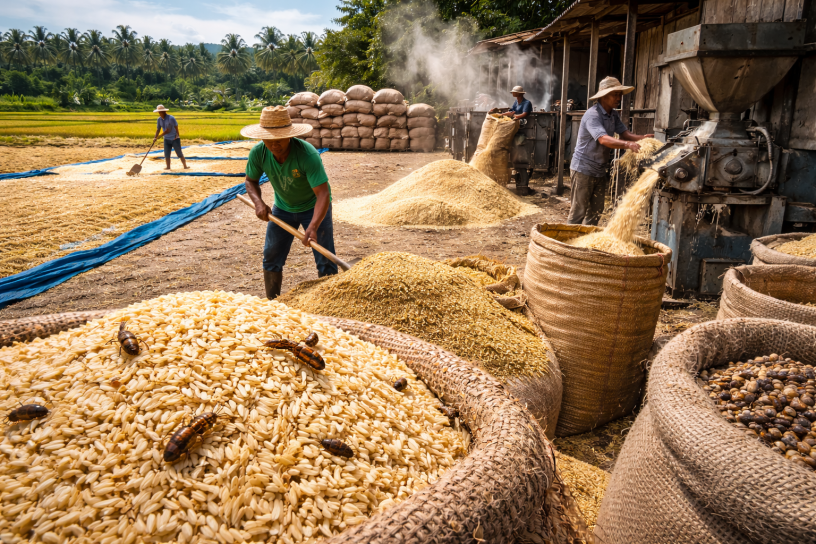
Sun drying remains common, especially among smallholders. While inexpensive, it is highly weather-dependent and difficult to manage consistently. Unexpected rain, uneven spreading, or contaminated surfaces increase losses and reduce quality (IRRI, 2013).
Mechanical and centralized dryers reduce these risks by providing controlled conditions. Where dryers are accessible and properly operated, post-harvest losses decline and grain quality becomes more consistent.
Storage Determines How Much Rice Survives
Storage losses occur through pests, moisture migration, and structural failure. Poorly sealed storage allows insects and rodents to consume grain. Inadequate ventilation encourages mold growth, especially in warm climates (World Bank, 2019).
Even small storage losses matter. When multiplied across thousands of farms, they represent a substantial reduction in available rice supply.
Milling Losses Reduce Edible Output
Milling converts paddy rice into edible grain, but inefficient milling reduces recovery rates. Old or poorly adjusted mills break grain, producing more fragments and waste. This lowers the amount of marketable rice produced from each harvest (FAO, 2014).
Improved milling technology and maintenance increase recovery rates, effectively producing more rice without planting additional land.
Loss Accumulates Across the Chain
Post-harvest losses rarely occur in a single dramatic failure. They accumulate in small amounts at each stage. A few percent lost during drying, a few more during storage, and additional losses during milling quickly add up.
Reducing losses at multiple points produces a larger gain than addressing only one stage.
Why Post-Harvest Loss Matters for Prices
Every kilogram of rice lost after harvest must be replaced through higher production or imports. Losses raise the cost per kilogram of rice that reaches consumers, even when harvest volumes are strong.
Reducing post-harvest loss is one of the fastest ways to increase effective rice supply. It improves farmer income, stabilizes prices, and strengthens food security without expanding farmland.
References
Food and Agriculture Organization of the United Nations. (2014). Rice post-harvest management. FAO.
Food and Agriculture Organization of the United Nations. (2017). Save food: Global initiative on food loss and waste. FAO.
International Rice Research Institute. (2013). Rice production manual. IRRI.
World Bank. (2019). Reducing food loss in developing countries: Policy and investment priorities. World Bank.
Discover more from WPS News
Subscribe to get the latest posts sent to your email.

