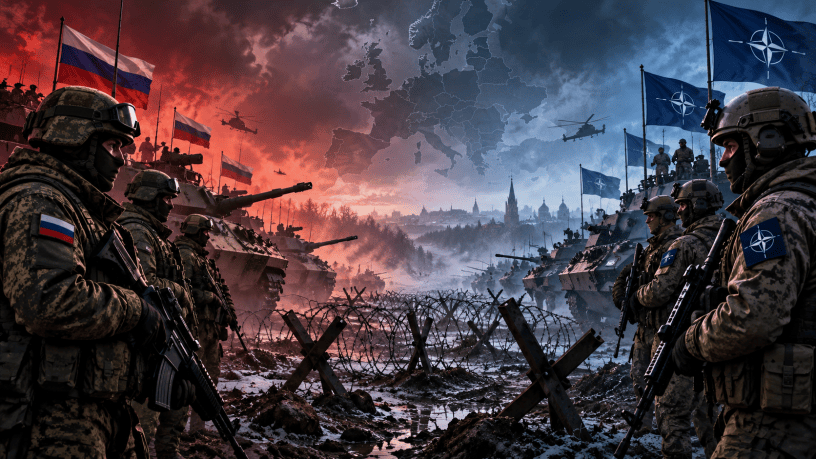
The United States Still Backs NATO—but Washington Is Deliberately Shifting More of the Conventional Burden to Europe
By Cliff Potts, Editor-in-Chief, WPS News
BAYBAY CITY, LEYTE, Philippines — Sunday, October 4, 2026
Support WPS News — Patreon: https://www.patreon.com/cw/WPSNews
ABOUT THIS SERIES
This article follows WPS News examinations of Switzerland’s armed neutrality, Germany’s conventional buildup, France’s expanding military role, Italy’s NATO commitments and a two-part survey of rearmament and defense-industrial expansion across Europe.
Those reports established that European governments are buying more ammunition, rebuilding air defenses, expanding ground forces, improving military infrastructure and placing multinational NATO formations farther east.
The remaining question is where the United States fits into that changing European defense system.
THE HISTORICAL BASELINE
Russia launched its full-scale invasion of Ukraine on February 24, 2022, after a conflict that began with Russia’s seizure of Crimea and intervention in eastern Ukraine in 2014.
The 2022 assault included an unsuccessful attempt to seize Kyiv. Russia subsequently concentrated heavily on eastern and southern Ukraine, while Ukraine retook substantial territory around Kharkiv and Kherson. The conflict evolved into a prolonged war of attrition involving artillery, drones, missiles, electronic warfare, fortified positions and attacks against infrastructure.
Russia continues to occupy substantial Ukrainian territory, but neither side has achieved the decisive military outcome sought earlier in the conflict.
The war has fundamentally altered NATO planning.
WHAT THE UNITED STATES IS ACTUALLY DOING
The United States remains a NATO member bound by Article 5.
At the July 2026 Ankara summit, all 32 allies reaffirmed collective defense and identified Russia as a long-term threat to Euro-Atlantic security. The declaration also states that European allies and Canada, working with the United States, are taking a larger role in alliance defense (NATO, 2026a).
Washington continues supplying military capabilities that remain difficult for European allies to replace quickly at comparable scale.
But the structure is changing.
European allies and Canada now finance most security assistance to Ukraine, while NATO is expanding European defense investment and manufacturing capacity. The United States remains part of that system without intending to provide the same proportion of Europe’s conventional forces that it supplied during previous decades (NATO, 2026a).
THE PENTAGON IS ADJUSTING U.S. FORCE LEVELS
On May 19, the Department of War announced that it had reduced the number of U.S. Brigade Combat Teams assigned to Europe from four to three, returning that portion of the force posture to its 2021 level.
The move temporarily delayed a planned deployment to Poland.
The Pentagon simultaneously said it intended to retain a strong military presence in Poland and would determine additional force changes after examining both U.S. requirements and the ability of European allies to contribute more forces (U.S. Department of War, 2026a).
That distinction is important.
A reduction in permanently or rotationally assigned American ground formations does not equal an American military withdrawal from Europe.
WHAT AMERICA’S ROLE IN EUROPE ACTUALLY INCLUDES
The administration has described a narrower but still substantial American role.
Under Secretary of War for Policy Elbridge Colby said in February that the United States intends to continue its extended nuclear deterrent for NATO, retain more limited and focused conventional capabilities, participate in alliance training and exercises, conduct joint military planning and prepare American forces to fulfill U.S. obligations under Article 5 (U.S. Department of War, 2026b).
That means American military involvement in Europe continues on several levels.
The United States remains part of NATO’s nuclear deterrence structure.
It continues participating in alliance command, planning, exercises and reinforcement.
It retains conventional forces in Europe.
And the United States maintains the ability to move additional military power into the European theater during a crisis.
Washington’s policy is therefore not to remove the United States from European defense.
It is to reduce how heavily European conventional defense depends upon American ground forces.
WHAT HEGSETH AND THE PENTAGON ARE SAYING
The Pentagon has stated this policy unusually clearly.
Colby told NATO defense ministers that European states should field most of the conventional forces required to deter—and if necessary defeat—conventional aggression in Europe.
At the same time, he explicitly said this does not constitute an American retreat from Europe (U.S. Department of War, 2026b).
Secretary of War Pete Hegseth has reinforced that message in meetings with European defense ministers, pressing governments to increase military spending, weapons production and combat readiness.
The underlying Pentagon argument is straightforward:
Russia remains a serious European security threat.
But Europe possesses the population, wealth and industrial capacity to provide far more of the forces required to confront that threat.
WHAT TRUMP IS SAYING
President Donald Trump has placed particular emphasis on defense spending.
The administration has pushed NATO allies toward much larger national defense budgets while emphasizing that European purchases can also expand American military production.
The Ankara summit reflected part of that shift. NATO announced more than $50 billion in new procurement commitments while European allies and Canada continued expanding military spending and industrial production (NATO, 2026a).
Trump is also pursuing negotiations intended to end the Ukraine war.
Those diplomatic efforts and the NATO military buildup are occurring simultaneously.
ANALYSIS
EUROPE AND AMERICA ARE ADDRESSING THE SAME PROBLEM FROM DIFFERENT POSITIONS
The United States and European NATO governments do not fundamentally disagree that Russia represents a continuing security challenge.
Their circumstances differ.
For Poland, Finland, Estonia, Latvia and Lithuania, Russia is geographically immediate.
For Germany, France and Italy, a larger Russia-NATO conflict would still be fought primarily in Europe.
Those countries therefore have strong incentives to build ground forces, artillery, air defense, ammunition reserves and transportation infrastructure designed to defend European territory.
The United States must plan not only for Europe but for the Indo-Pacific, the Middle East, nuclear deterrence, homeland defense and other global commitments.
Washington is consequently trying to reduce the amount of American conventional military capacity permanently tied to Europe while preserving U.S. participation in NATO.
THE TRANSITION RISK IS A CAPABILITY GAP
This is the most important uncertainty in the current policy.
The danger is not that Article 5 suddenly disappears.
The danger is timing.
The Pentagon can remove or reassign an existing American combat formation comparatively quickly.
Europe cannot create an equally capable replacement overnight.
A new brigade requires trained soldiers, officers, equipment, ammunition, maintenance, logistics and repeated exercises before it becomes a reliable combat formation.
Expanded air defense requires launchers, radar systems and interceptors.
Larger ammunition reserves require factories capable of producing them.
NATO is simultaneously seeking greater capability in integrated air and missile defense, long-range precision strike, unmanned systems, intelligence and the ability to deploy and sustain forces (NATO, 2026a).
The transition risk is therefore a temporary mismatch between what the United States reduces and what Europe has actually made operational.
That is different from saying NATO is defenseless.
It means the credibility of the new arrangement depends upon the pace at which European plans become functioning military capability.
AMERICA IS NOT LEAVING—ITS FUNCTION IS CHANGING
The administration’s intended end state is visible in its own statements.
Europe would provide most of the conventional forces necessary to defend European territory.
The United States would remain a NATO ally, continue extending nuclear deterrence, contribute selected conventional capabilities, participate in planning and exercises, and retain the ability to reinforce the theater.
Colby summarized the intended model as a NATO in which Europe serves as the primary conventional defender of the European theater while American strategic power and global reach remain behind the alliance (U.S. Department of War, 2026b).
That is a significant change from the post-Cold War assumption that the United States would routinely provide a disproportionate amount of NATO’s high-end military power.
It is not the same thing as ending the transatlantic alliance.
WHY THE NEXT FEW YEARS MATTER
Europe has already begun increasing defense budgets and industrial production.
NATO says European allies and Canada increased core defense investment by more than $139 billion after the 2025 Hague commitments and are now moving from spending promises toward delivering actual military capabilities (NATO, 2026a; 2026b).
But budgets are inputs.
Combat-ready forces are outputs.
That difference is what matters.
A government can authorize money this year while the additional ammunition factory, air-defense battery or trained brigade appears years later.
The success of the new NATO arrangement therefore depends upon whether American force adjustments and European capability growth remain synchronized.
READER TAKEAWAY
The United States has not abandoned Europe.
It remains bound by NATO, maintains forces on the continent, extends nuclear deterrence to the alliance and intends to participate if Article 5 collective defense becomes necessary.
What is changing is the composition of NATO’s military power.
European governments are being expected to provide much more of the conventional force required to defend European territory.
The critical question is whether those forces become operational before American conventional reductions create vulnerabilities that neither side intended.
That—not whether the United States has simply “left Europe”—is the transition worth watching.
APA-Style Sources
NATO. (2026a, July 8). The Ankara Summit Declaration.
NATO — The Ankara Summit Declaration
NATO. (2026b, July 8). Secretary General on the Ankara Summit: NATO delivers.
NATO — Ankara Summit Results
U.S. Department of War. (2026a, May 19). Statement attributable to Assistant to the Secretary of War for Public Affairs.
Department of War — U.S. Force Posture in Europe
U.S. Department of War. (2026b, February 12). Remarks by Under Secretary of War for Policy Elbridge Colby at the NATO Defense Ministerial.
Department of War — Colby NATO Defense Ministerial Remarks
Discover more from WPS News
Subscribe to get the latest posts sent to your email.

