Why Survival Depends on Cooperation, Not Individualism
By Cliff Potts, CSO, and Editor-in-Chief of WPS News
Baybay City, Leyte, Philippines — October 5, 2026
Division of Labor Saves Lives
In most survival fiction, everyone does everything.
Characters fight, scavenge, build, treat injuries, plan strategy, and maintain security—often all within the same small group, sometimes within the same individual.
It creates a sense of competence and control.
It also ignores one of the most important principles of human survival: specialization.
The Myth
The myth is that a capable individual—or a small group of equally capable individuals—can perform all necessary survival functions.
In this model:
- Skills are interchangeable
- Roles are fluid without consequence
- Competence is assumed across domains
This suggests that survival is simply a matter of effort and determination.
It is not.
Why People Believe It
The belief comes from both storytelling and perception.
Stories simplify roles to keep narratives moving. A character who can do everything keeps the plot efficient.
In real life, people often underestimate the complexity of tasks they do not regularly perform. Activities like water purification, medical care, food production, or structural repair appear straightforward from a distance.
They are not.
Why It Fails in Reality
Modern survival depends on layered systems of expertise.
Even basic functions require knowledge and practice:
- Water safety involves contamination awareness and treatment methods
- Medical care requires training, not guesswork
- Food production depends on timing, environment, and technique
- Structural work requires understanding materials and load
No individual can master all of these areas at once, especially under stress.
Attempts to do so lead to errors, inefficiencies, and risk.
History demonstrates the opposite approach.
During World War II, success depended on dividing tasks across millions of people, each contributing within a specific role—manufacturing, logistics, communications, medicine, and command.
No one did everything.
Everyone did something.
What Actually Works
Division of labor increases both efficiency and survival.
In a functional group:
- Tasks are assigned based on ability
- Skills are developed through repetition
- Time is used more effectively
- Errors are reduced through familiarity
This allows the group to maintain multiple critical functions at once.
It also creates resilience. If one person is unavailable, others can step in—if the system is designed correctly.
The Value of Non-Obvious Skills
Some of the most important roles in survival are not immediately visible.
- Planning and coordination
- Inventory and resource tracking
- Communication and information management
- Scheduling and prioritization
These functions often determine whether resources are used effectively or wasted.
They are as critical as physical labor.
A group that ignores these roles may appear active, but it will be disorganized.
Disorganization reduces survival.
A System, Not a Collection of Individuals
Division of labor transforms a group into a system.
Instead of individuals acting independently, the group operates as interconnected parts.
Each role supports others:
- Food supports labor
- Labor maintains shelter
- Shelter protects health
- Health sustains participation
This interdependence is not a weakness. It is the structure that allows survival to continue over time.
Practical Takeaway
If you are preparing for disruption, think in terms of roles.
- Identify essential functions (water, food, medical, coordination)
- Match people to roles based on ability
- Cross-train where possible
- Avoid assuming one person can do everything
A small group with clear roles will outperform a larger group without them.
Conclusion
Survival is not about individual capability.
It is about collective function.
The idea that everyone can do everything is appealing because it simplifies reality.
But real-world survival depends on complexity—managed through specialization and coordination.
Collapse does not reward those who try to do it all.
It rewards those who work together to do what is necessary.
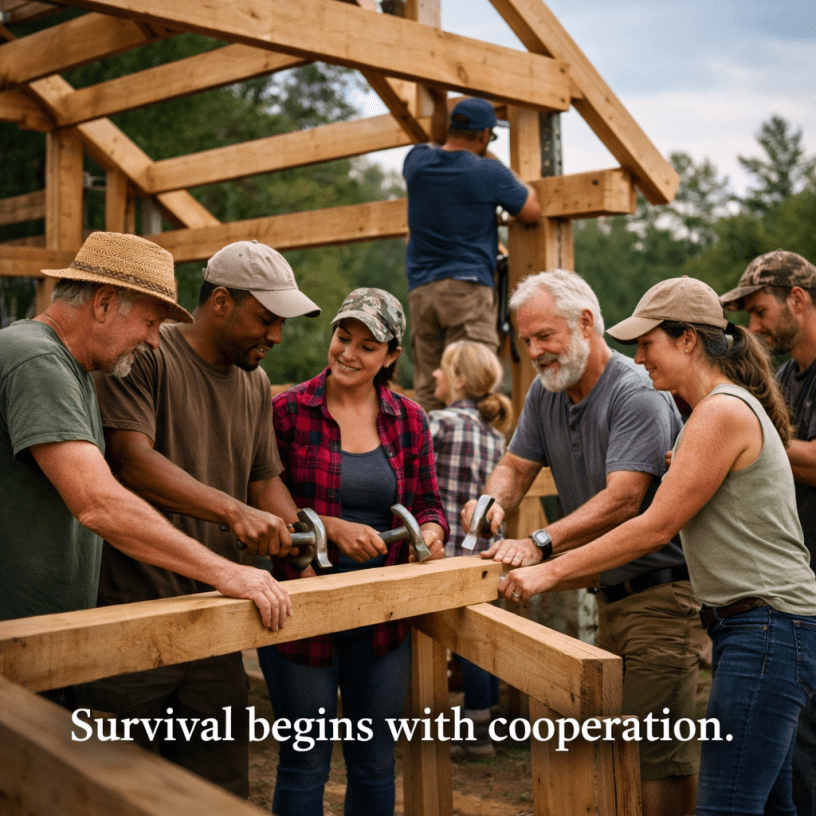
Survival begins with cooperation.
For more social commentary, please see Occupy 2.5 at https://Occupy25.com
If you read this and it matters, help me keep it going: https://www.patreon.com/cw/WPSNews
References
Durkheim, É. (1893). The Division of Labor in Society. Free Press.
Keegan, J. (1989). The Second World War. Viking.
Smith, A. (1776). The Wealth of Nations.
Discover more from WPS News
Subscribe to get the latest posts sent to your email.

