The American Civil War: Civic Life Series (Part 10 of 18)
By Cliff Potts, CSO, and Editor-in-Chief of WPS News
Baybay City, Leyte, Philippines
October 20, 2026
The war did not only expand the power of the state. It deputized ordinary people.
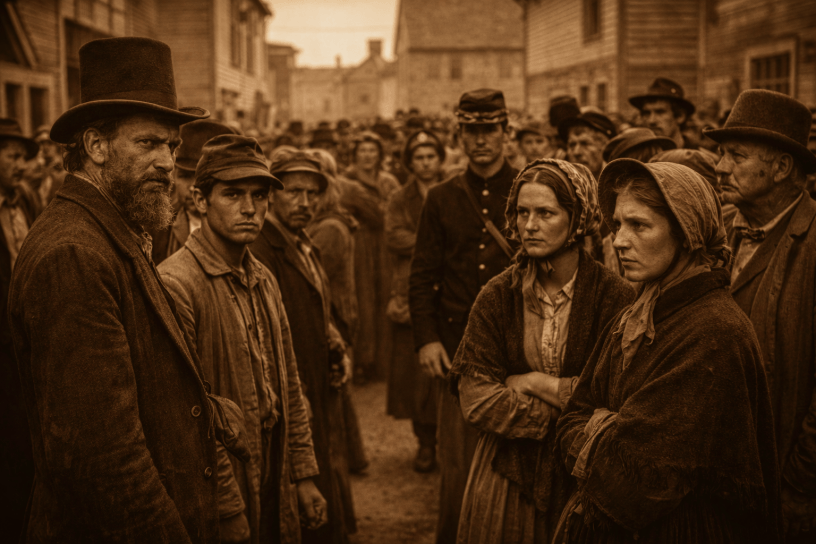
As the Civil War deepened, loyalty ceased to be a private matter. It became something to be observed, assessed, and reported. Communities that had already absorbed hunger, conscription, and economic collapse now faced a quieter threat: suspicion.
The danger was no longer just what the government demanded, but what neighbors expected.
When Loyalty Becomes Performative
In wartime America, neutrality narrowed. Silence began to look like evasion. Private doubts risked being read as disloyalty. People learned quickly that opinions expressed at home could reappear elsewhere, stripped of context.
Public behavior adjusted accordingly. Flags appeared in windows. Newspapers were chosen carefully. Church attendance became a signal. Speech flattened into safe phrases. To deviate was to invite attention.
Loyalty was no longer something felt. It was something demonstrated.
Rumor as Social Currency
Information traveled faster by mouth than by mail. Rumors filled gaps left by delayed correspondence and censored presses. Some were benign. Others were destructive.
A careless comment could spread quickly. An old argument could be reframed as treason. Personal grudges found new justification under the language of patriotism. Accusations did not need proof to do damage; they needed repetition.
Rumor became a form of power—cheap, deniable, and effective.
Informal Surveillance
Formal surveillance was limited by manpower and reach. Informal surveillance was not.
Neighbors watched one another’s habits. Who attended which meetings. Who spoke too loudly—or not at all. Who received letters and from whom. Deviations from expectation drew notice.
This scrutiny was rarely framed as malice. It was described as responsibility. People told themselves they were protecting their community, their sons, their cause. In doing so, they normalized intrusion into private life.
Communities learned to police themselves.
The Cost of Being Suspected
Once suspicion attached to a person or household, it was difficult to remove. Trade declined. Assistance evaporated. Invitations stopped. Silence followed.
The accused often did not know what they had done wrong. That uncertainty compounded the punishment. Correction was impossible when the charge was undefined.
Fear did not need prisons to work. It only needed isolation.
Women, Children, and the Burden of Appearance
Women shouldered much of the work of maintaining acceptable appearances. They moderated speech, instructed children on what not to repeat, and managed interactions with neighbors carefully.
Children absorbed these lessons early. They learned which topics were dangerous. They learned that curiosity could be costly. Loyalty was taught not as belief, but as caution.
This education outlasted the war.
Trust as a Casualty
Communities that once relied on cooperation became brittle. Mutual aid narrowed. Help was offered selectively. Every interaction carried calculation.
The irony was sharp: even as people proclaimed unity, lived trust declined. Public conformity masked private fracture.
The war did not need to be present in the street to reshape civic life. It lived inside relationships.
Looking Back
The Civil War revealed how quickly societies under strain turn inward. When legitimacy is contested and survival is uncertain, people look for threats nearby. Watching becomes easier than trusting. Accusation feels safer than silence.
This is the tenth truth of civic breakdown: when loyalty is enforced socially, freedom erodes quietly.
The war did not only conscript bodies.
It conscripted vigilance—and turned neighbors into witnesses against one another.
McPherson, J. M. (1988). Battle cry of freedom: The Civil War era. Oxford University Press.
Neely, M. E. (1991). The fate of liberty: Abraham Lincoln and civil liberties. Oxford University Press.
McCurry, S. (2010). Confederate reckoning: Power and politics in the Civil War South. Harvard University Press.
Faust, D. G. (2008). This republic of suffering: Death and the American Civil War. Alfred A. Knopf.
Blight, D. W. (2001). Race and reunion: The Civil War in American memory. Harvard University Press.
Library of Congress. (n.d.). Civil War diaries and letters. Manuscript Division. https://www.loc.gov/collections/civil-war
Library of Congress. (n.d.). Chronicling America: Historic American newspapers. https://chroniclingamerica.loc.gov
Discover more from WPS News
Subscribe to get the latest posts sent to your email.

