By Cliff Potts, CSO, and Editor-in-Chief of WPS News
Baybay City, Leyte, Philippines — August 31, 2026
Mechanization is often treated as a single decision: mechanize or do not mechanize. In practice, this framing creates inefficiencies. Rice systems do not benefit equally from machines at every stage of production. The most effective use of mechanization is targeted, focused on the specific points where delays and losses cause the greatest damage to yield and quality (IRRI, 2013; FAO, 2017).
When mechanization is applied without regard to bottlenecks, it raises costs without improving outcomes.
Not All Farm Tasks Create the Same Risk
Some farm operations can tolerate delay. Others cannot. Land preparation, transplanting, harvesting, threshing, and drying all occur within narrow time windows. When these tasks are late, losses increase rapidly through shattering, lodging, and grain deterioration (FAO, 2014).
Mechanization delivers the greatest value where timing matters most. Harvesting rice at the right moment protects both quantity and quality, while delays in lower-risk tasks have far smaller effects on total output.
Harvest and Post-Harvest Come First
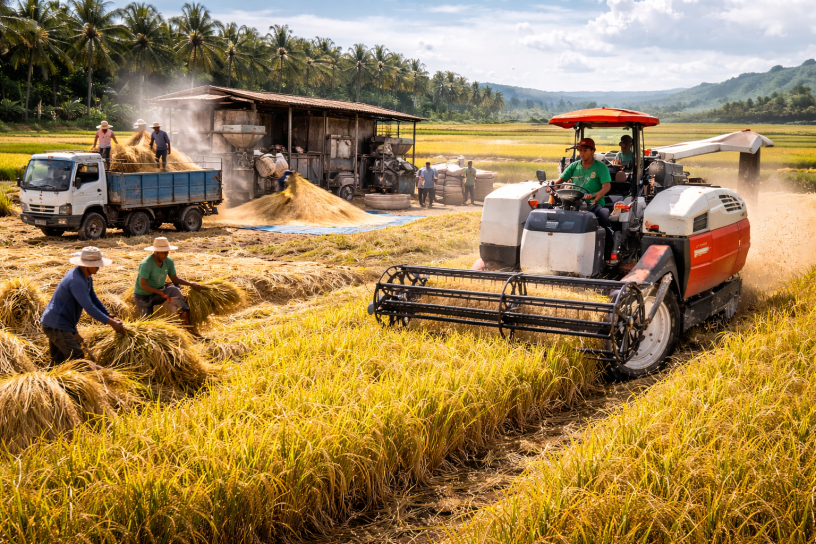
Harvesting is one of the most labor- and time-sensitive stages in rice production. When labor or equipment is unavailable, crops may remain in the field beyond optimal maturity. Even short delays reduce recoverable grain and milling quality (IRRI, 2013).
Mechanical harvesters, when matched to local field conditions, allow crops to be harvested within optimal windows. This reduces exposure to weather-related damage and stabilizes production. Drying is equally critical. Grain harvested at high moisture deteriorates rapidly if not dried promptly. Mechanical and centralized dryers reduce dependence on weather and significantly lower post-harvest losses (FAO, 2017).
Shared Equipment Reduces Costs
Agricultural machinery requires substantial capital investment. For many small and medium farmers, individual ownership is neither practical nor efficient. Shared access through cooperatives, service providers, or local equipment pools spreads costs across many users and increases utilization rates (World Bank, 2019).
Higher utilization lowers per-unit costs, improves maintenance discipline, and reduces idle equipment during critical periods.
Matching Machines to Field Conditions
Mechanization fails when machines are poorly matched to local conditions. Small, fragmented, uneven, or poorly drained fields may not support large equipment efficiently. In these settings, smaller or specialized machines often perform better and cause less damage to fields and crops (IRRI, 2018).
Effective mechanization begins with field assessment rather than equipment acquisition. Machines should fit the land, not force the land to adapt to inappropriate technology.
Mechanization Is a System Choice
Machines do not operate in isolation. They depend on fuel availability, spare parts, trained operators, and maintenance systems. When these supports are weak, equipment may sit idle during critical periods. Mechanization therefore succeeds only when embedded within functioning service and logistics systems (FAO, 2014).
Coordination further increases returns. Staggered planting schedules, shared booking systems, and clear harvest priorities reduce competition for machinery and improve overall system efficiency.
Why Selective Mechanization Works
Targeted mechanization produces immediate, measurable gains by addressing the most damaging constraints first. It reduces losses, stabilizes timing, and lowers risk without requiring full-scale transformation of farm practices.
By focusing on bottlenecks rather than blanket modernization, rice systems can improve efficiency while keeping costs under control. This approach aligns technology with real constraints and supports stable production across diverse farming environments.
References
Food and Agriculture Organization of the United Nations. (2014). Mechanization for rural development: A review of patterns and progress from around the world. FAO.
Food and Agriculture Organization of the United Nations. (2017). Rice post-harvest management. FAO.
International Rice Research Institute. (2013). Rice production manual. IRRI.
International Rice Research Institute. (2018). Farm mechanization in Asia: Status, challenges, and opportunities. IRRI.
World Bank. (2019). Transforming Philippine agriculture: Mechanization and value chain efficiency. World Bank.
Discover more from WPS News
Subscribe to get the latest posts sent to your email.

